Graph each function. Give the domain and range. ƒ(x) = (1/3)x+2 - 1
Table of contents
- 0. Review of Algebra4h 18m
- 1. Equations & Inequalities3h 18m
- 2. Graphs of Equations1h 43m
- 3. Functions2h 17m
- 4. Polynomial Functions1h 44m
- 5. Rational Functions1h 23m
- 6. Exponential & Logarithmic Functions2h 28m
- 7. Systems of Equations & Matrices4h 5m
- 8. Conic Sections2h 23m
- 9. Sequences, Series, & Induction1h 22m
- 10. Combinatorics & Probability1h 45m
6. Exponential & Logarithmic Functions
Introduction to Exponential Functions
Problem 116b
Textbook Question
Concept Check. If ƒ(x) = a^x and ƒ(3) = 27, determine each function value. ƒ(-1)
Verified step by step guidance1
Identify the given function: \(f(x) = a^{x}\), where \(a\) is the base we need to find.
Use the given information \(f(3) = 27\) to set up the equation: \(a^{3} = 27\).
Solve for \(a\) by taking the cube root of both sides: \(a = \sqrt[3]{27}\).
Once you find the value of \(a\), substitute it back into the function to find \(f(-1)\): \(f(-1) = a^{-1}\).
Recall that \(a^{-1} = \frac{1}{a}\), so express \(f(-1)\) as \(\frac{1}{a}\) using the value of \(a\) found.
Verified video answer for a similar problem:This video solution was recommended by our tutors as helpful for the problem above
Video duration:
4mPlay a video:
Was this helpful?
Key Concepts
Here are the essential concepts you must grasp in order to answer the question correctly.
Exponential Functions
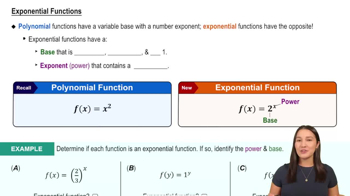
An exponential function has the form f(x) = a^x, where the base a is a positive constant. The function grows or decays depending on whether a is greater than or less than 1. Understanding this form is essential to evaluate the function at different values of x.
Recommended video:
Exponential Functions
Solving for the Base in an Exponential Function
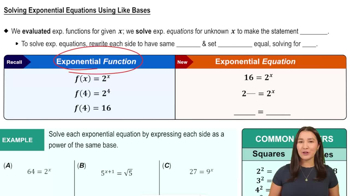
Given a function value like f(3) = 27, you can find the base a by solving the equation a^3 = 27. This involves recognizing that 27 is a power of 3, so a can be determined by taking the cube root of 27, which is crucial for evaluating the function at other points.
Recommended video:
Solving Exponential Equations Using Like Bases
Evaluating the Function at Negative Exponents
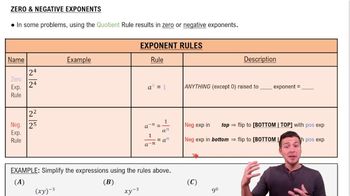
To find f(-1) when f(x) = a^x, use the property of exponents that a^{-1} = 1/a. This means evaluating the function at a negative exponent involves taking the reciprocal of the base, which is important for correctly determining function values for negative inputs.
Recommended video:
Guided course
Zero and Negative Rules
Watch next
Master Exponential Functions with a bite sized video explanation from Patrick
Start learningRelated Videos
Related Practice
Textbook Question
599
views