Use the compound interest formulas A = P (1+ r/n)nt and A =Pert to solve exercises 53-56. Round answers to the nearest cent. Suppose that you have \$12,000 to invest. Which investment yields the greater return over 3 years: 0.96% compounded monthly or 0.95% compounded continuously?
Table of contents
- 0. Review of Algebra4h 18m
- 1. Equations & Inequalities3h 18m
- 2. Graphs of Equations1h 43m
- 3. Functions2h 17m
- 4. Polynomial Functions1h 44m
- 5. Rational Functions1h 23m
- 6. Exponential & Logarithmic Functions2h 28m
- 7. Systems of Equations & Matrices4h 5m
- 8. Conic Sections2h 23m
- 9. Sequences, Series, & Induction1h 22m
- 10. Combinatorics & Probability1h 45m
6. Exponential & Logarithmic Functions
Introduction to Exponential Functions
Problem 81
Textbook Question
Solve each equation. 4x-2 = 23x+3
Verified step by step guidance1
Recognize that the bases on both sides of the equation can be expressed as powers of the same base. Since 4 and 2 are related by 4 = 2^2, rewrite 4^(x-2) as (2^2)^(x-2).
Apply the power of a power property: (a^m)^n = a^{m \cdot n}. So, (2^2)^{x-2} becomes 2^{2(x-2)}.
Rewrite the equation with the same base: 2^{2(x-2)} = 2^{3x+3}.
Since the bases are the same and the expressions are equal, set the exponents equal to each other: 2(x-2) = 3x + 3.
Solve the resulting linear equation for x by expanding and isolating x: 2x - 4 = 3x + 3.
Verified video answer for a similar problem:This video solution was recommended by our tutors as helpful for the problem above
Video duration:
2mPlay a video:
Was this helpful?
Key Concepts
Here are the essential concepts you must grasp in order to answer the question correctly.
Exponential Equations
Exponential equations involve variables in the exponent position. Solving them often requires rewriting expressions with a common base or using logarithms to isolate the variable. Understanding how to manipulate exponents is essential for finding solutions.
Recommended video:
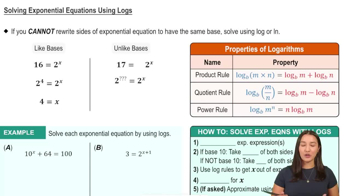
Solving Exponential Equations Using Logs
Properties of Exponents
Properties of exponents, such as the product, quotient, and power rules, allow simplification and rewriting of exponential expressions. For example, expressing 4 as 2 squared helps rewrite 4^(x-2) as (2^2)^(x-2) = 2^(2x-4), enabling comparison of exponents with the same base.
Recommended video:
Guided course
Rational Exponents
Equating Exponents
When exponential expressions have the same base and are set equal, their exponents must be equal. This principle allows converting an exponential equation into a linear equation in terms of the variable, which can then be solved using algebraic methods.
Recommended video:
Guided course
Rational Exponents
Watch next
Master Exponential Functions with a bite sized video explanation from Patrick
Start learningRelated Videos
Related Practice
Textbook Question
613
views