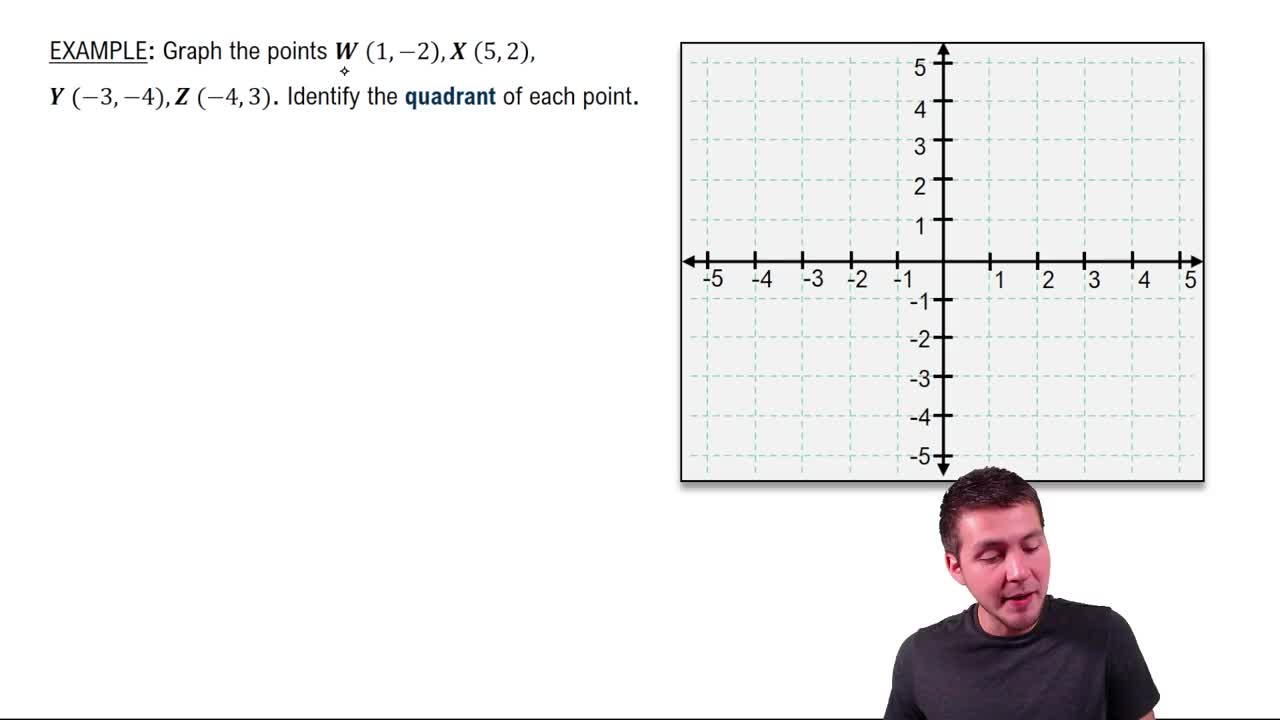
Plot the given point in a rectangular coordinate system. (- 4, - 2)
Verified step by step guidance
1
Step 1: Understand the rectangular coordinate system. It consists of two perpendicular axes: the horizontal axis (x-axis) and the vertical axis (y-axis). The point (-4, -2) is given in the form (x, y), where -4 is the x-coordinate and -2 is the y-coordinate.
Step 2: Identify the x-coordinate (-4). This tells you how far to move horizontally from the origin (0, 0). Since the x-coordinate is negative, move 4 units to the left along the x-axis.
Step 3: Identify the y-coordinate (-2). This tells you how far to move vertically from the x-coordinate position. Since the y-coordinate is negative, move 2 units downward from the x-coordinate position.
Step 4: Mark the point (-4, -2) on the graph. After moving 4 units left and 2 units down, place a dot at that location to represent the point.
Step 5: Label the point (-4, -2) on the graph for clarity. This ensures that the plotted point is easily identifiable.
Verified video answer for a similar problem:
This video solution was recommended by our tutors as helpful for the problem above
Video duration:
1m
Play a video:
0 Comments
Key Concepts
Here are the essential concepts you must grasp in order to answer the question correctly.
Rectangular Coordinate System
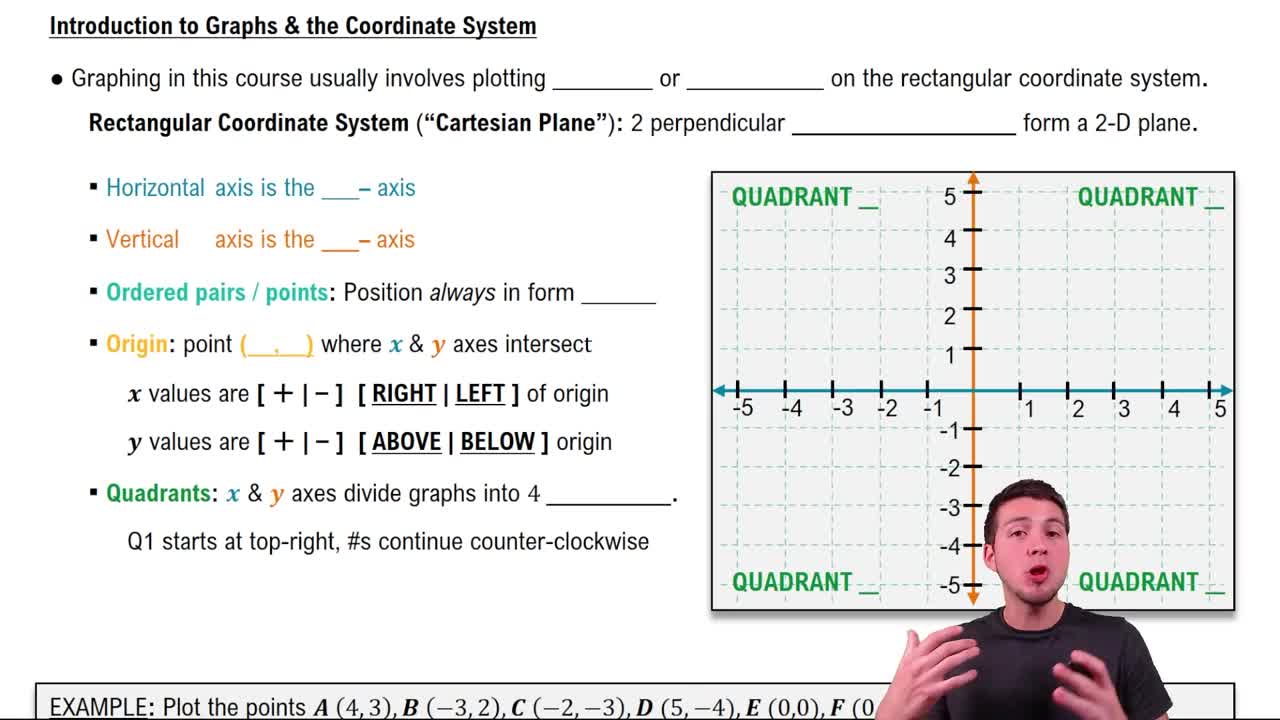
A rectangular coordinate system, also known as the Cartesian coordinate system, consists of two perpendicular axes: the x-axis (horizontal) and the y-axis (vertical). Each point in this system is defined by an ordered pair (x, y), where 'x' indicates the horizontal position and 'y' indicates the vertical position. Understanding this system is essential for accurately plotting points and visualizing relationships between them.
An ordered pair is a pair of numbers used to represent a point in a coordinate system, written in the form (x, y). The first number, 'x', represents the horizontal distance from the origin, while the second number, 'y', represents the vertical distance. The order of the numbers is crucial, as switching them would place the point in a different location within the coordinate system.
The coordinate plane is divided into four quadrants based on the signs of the x and y coordinates. Quadrant I contains points where both coordinates are positive, Quadrant II has negative x and positive y, Quadrant III has both negative coordinates, and Quadrant IV has positive x and negative y. Knowing the location of these quadrants helps in determining where to plot points like (-4, -2), which lies in Quadrant III.

 1:20 minutes
 Verified step by step guidance
 05:10
05:10