Solve each equation. Then state whether the equation is an identity, a conditional equation, or an inconsistent equation. (3x+1)/3 - 13/2 = (1-x)/4
Ch. 1 - Equations and Inequalities

Chapter 2, Problem 27a
Graph each equation in Exercises 13 - 28. Let x = - 3, - 2, - 1, 0, 1, 2, 3
y = x3
Verified step by step guidance1
Identify the given equation: y = x^3. This is a cubic function, which means the graph will have a characteristic S-shape, passing through the origin (0, 0).
Create a table of values for the given x-values: x = -3, -2, -1, 0, 1, 2, 3. For each x-value, substitute it into the equation y = x^3 to calculate the corresponding y-value. For example, when x = -3, y = (-3)^3 = -27.
Complete the table of values by calculating y for all the given x-values. The table will look like this: x = -3, -2, -1, 0, 1, 2, 3 and corresponding y-values will be calculated as y = x^3.
Plot the points from the table of values on a coordinate plane. For example, plot (-3, -27), (-2, -8), (-1, -1), (0, 0), (1, 1), (2, 8), and (3, 27).
Draw a smooth curve through the plotted points to represent the graph of the cubic function y = x^3. Ensure the curve reflects the S-shape characteristic of cubic functions, with the graph decreasing for negative x-values, passing through the origin, and increasing for positive x-values.

Verified video answer for a similar problem:
This video solution was recommended by our tutors as helpful for the problem above.
Video duration:
2mWas this helpful?
Key Concepts
Here are the essential concepts you must grasp in order to answer the question correctly.
Graphing Functions
Graphing functions involves plotting points on a coordinate plane to visualize the relationship between the input (x-values) and output (y-values). For the equation y = x^3, each x-value corresponds to a specific y-value calculated by cubing x. Understanding how to plot these points accurately is essential for interpreting the function's behavior.
Recommended video:
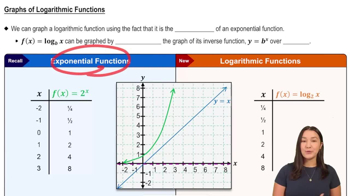
Graphs of Logarithmic Functions
Cubic Functions
Cubic functions are polynomial functions of degree three, characterized by their general form y = ax^3 + bx^2 + cx + d. The function y = x^3 is a simple cubic function where a = 1, b = 0, c = 0, and d = 0. These functions typically exhibit an S-shaped curve and can have one or two turning points, influencing their graph's shape and direction.
Recommended video:
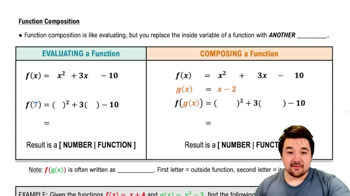
Function Composition
Evaluating Functions
Evaluating functions involves substituting specific values for the variable to find corresponding outputs. In this case, substituting x = -3, -2, -1, 0, 1, 2, and 3 into the equation y = x^3 allows us to calculate the y-values. This process is crucial for generating the points needed to accurately graph the function.
Recommended video:
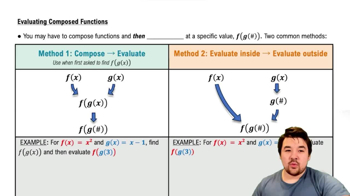
Evaluating Composed Functions
Related Practice
Textbook Question
1008
views
Textbook Question
Graph each equation in Exercises 13 - 28. Let x = - 3, - 2, - 1, 0, 1, 2, 3
y = x3 - 1
975
views
Textbook Question
The length of a rectangular pool is 6 meters less than twice the width. If the pool's perimeter is 126 meters, what are its dimensions?
766
views
Textbook Question
In all exercises, other than exercises with no solution, use interval notation to express solution sets and graph each solution set on a number line. In Exercises 27–50, solve each linear inequality. 3x - 7 ≥ 13
909
views
Textbook Question
In all exercises, other than exercises with no solution, use interval notation to express solution sets and graph each solution set on a number line. In Exercises 27–50, solve each linear inequality. 5x + 11 < 26
757
views
Textbook Question
Solve each radical equation in Exercises 11–30. Check all proposed solutions. √(2x + 3) + √(x - 2) = 2
787
views