Determine whether each relation defines a function, and give the domain and range. See Examples 1–4.
Table of contents
- 0. Review of Algebra4h 18m
- 1. Equations & Inequalities3h 18m
- 2. Graphs of Equations1h 43m
- 3. Functions2h 17m
- 4. Polynomial Functions1h 44m
- 5. Rational Functions1h 23m
- 6. Exponential & Logarithmic Functions2h 28m
- 7. Systems of Equations & Matrices4h 5m
- 8. Conic Sections2h 23m
- 9. Sequences, Series, & Induction1h 22m
- 10. Combinatorics & Probability1h 45m
3. Functions
Intro to Functions & Their Graphs
Problem 53
Textbook Question
Let ƒ(x)=-3x+4 and g(x)=-x^2+4x+1. Find each of the following. Simplify if necessary. See Example 6. g(-2)
Verified step by step guidance1
Identify the function g(x) given as \(g(x) = -x^2 + 4x + 1\).
To find \(g(-2)\), substitute \(x = -2\) into the function \(g(x)\).
Replace every \(x\) in the expression with \(-2\): \(g(-2) = -(-2)^2 + 4(-2) + 1\).
Calculate each term step-by-step: first compute \((-2)^2\), then multiply by \(-1\), then multiply \$4\( by \)-2\(, and finally add \)1$.
Combine all the results to simplify the expression and find the value of \(g(-2)\).
Verified video answer for a similar problem:This video solution was recommended by our tutors as helpful for the problem above
Video duration:
1mPlay a video:
Was this helpful?
Key Concepts
Here are the essential concepts you must grasp in order to answer the question correctly.
Function Evaluation
Function evaluation involves substituting a given input value into the function's formula and calculating the result. For example, to find g(-2), replace every x in g(x) with -2 and simplify the expression.
Recommended video:
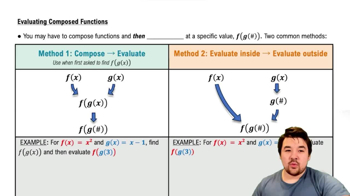
Evaluating Composed Functions
Polynomial Functions
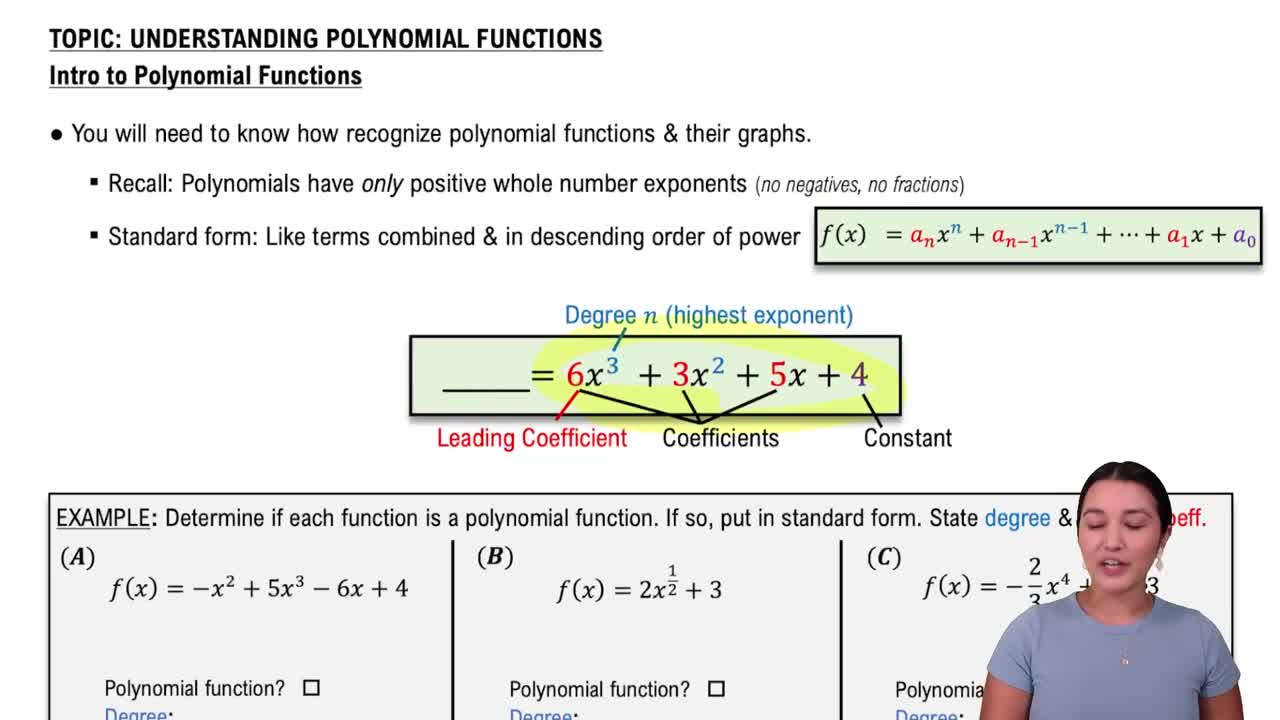
Polynomial functions are expressions involving variables raised to whole-number exponents combined using addition, subtraction, and multiplication. Understanding how to work with polynomials, like g(x) = -x² + 4x + 1, is essential for evaluating and simplifying expressions.
Recommended video:
Introduction to Polynomial Functions
Order of Operations
The order of operations dictates the sequence in which mathematical operations are performed: parentheses, exponents, multiplication/division, and addition/subtraction. Correctly applying this order ensures accurate simplification when evaluating functions.
Recommended video:
Guided course
Performing Row Operations on Matrices
Watch next
Master Relations and Functions with a bite sized video explanation from Patrick
Start learningRelated Videos
Related Practice
Textbook Question
605
views