Identify the dividend and divisor: the dividend is and the divisor is .
Set up polynomial long division by dividing the leading term of the dividend, , by the leading term of the divisor, . This gives the first term of the quotient.
Multiply the entire divisor by the term found in the previous step and subtract the result from the dividend to find the new polynomial to divide.
Repeat the division process with the new polynomial: divide its leading term by the leading term of the divisor, multiply the divisor by this new term, and subtract again.
Continue this process until the degree of the remainder is less than the degree of the divisor. The quotient is the sum of all terms found, and the remainder (if any) is written over the original divisor.
Verified video answer for a similar problem:
This video solution was recommended by our tutors as helpful for the problem above
Video duration:
5m
Play a video:
Was this helpful?
Key Concepts
Here are the essential concepts you must grasp in order to answer the question correctly.
Polynomial Long Division
Polynomial long division is a method used to divide a polynomial by another polynomial of lower or equal degree. It involves dividing the leading term of the dividend by the leading term of the divisor, multiplying the divisor by this result, subtracting from the dividend, and repeating until the remainder has a lower degree than the divisor.
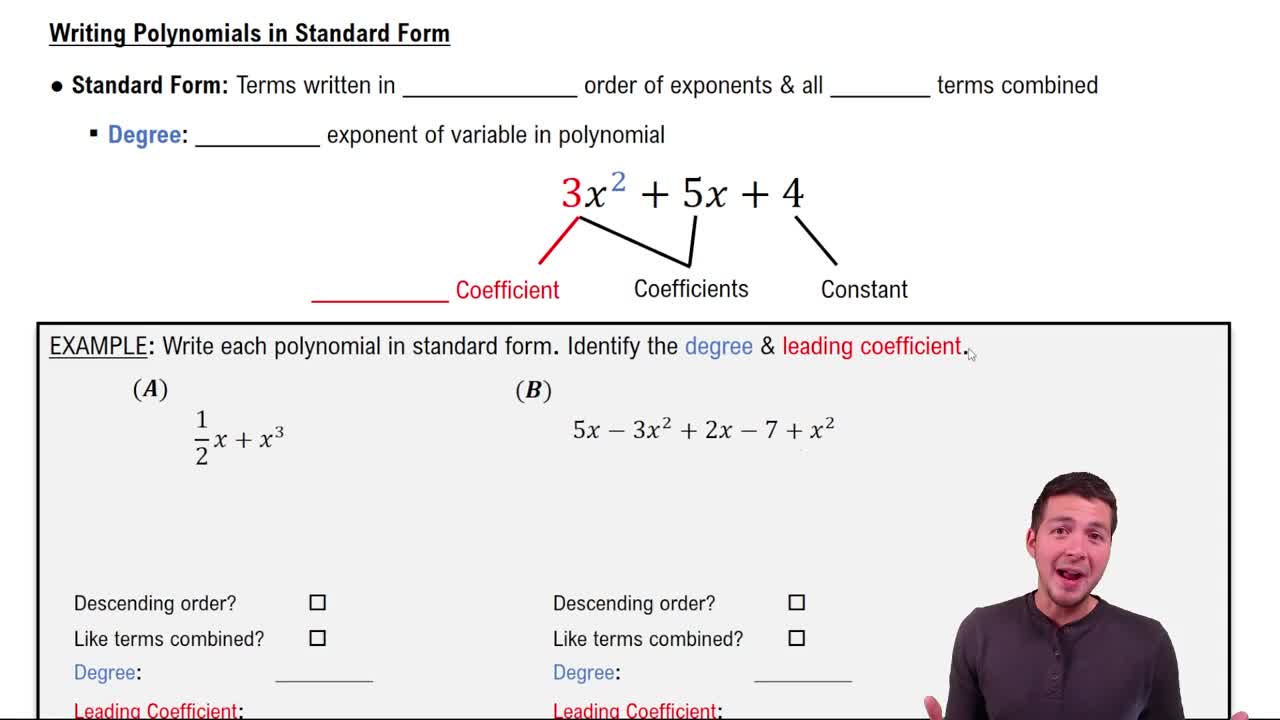
The degree of a polynomial is the highest power of the variable in the expression. Understanding the degree helps determine the number of steps in division and when to stop, as the division process ends when the remainder's degree is less than the divisor's degree.
In polynomial division, the quotient is the result of the division, and the remainder is what is left over when the division cannot continue. The original polynomial can be expressed as (divisor × quotient) + remainder, which is essential for verifying the division's correctness.