For each equation, (a) give a table with at least three ordered pairs that are solutions, and (b) graph the equation. y=x2
Table of contents
- 0. Review of Algebra4h 18m
- 1. Equations & Inequalities3h 18m
- 2. Graphs of Equations1h 43m
- 3. Functions2h 17m
- 4. Polynomial Functions1h 44m
- 5. Rational Functions1h 23m
- 6. Exponential & Logarithmic Functions2h 28m
- 7. Systems of Equations & Matrices4h 5m
- 8. Conic Sections2h 23m
- 9. Sequences, Series, & Induction1h 22m
- 10. Combinatorics & Probability1h 45m
3. Functions
Intro to Functions & Their Graphs
Problem 30
Textbook Question
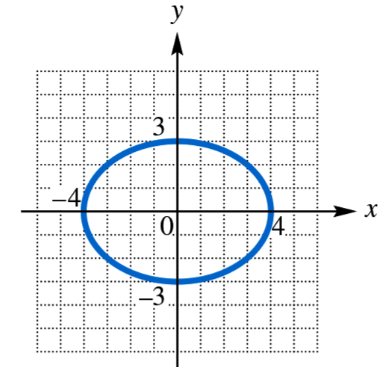
Determine whether each relation defines a function, and give the domain and range.

Verified step by step guidance1
Step 1: Identify the relation shown on the graph. The graph depicts an oval shape, which is a closed curve representing a set of points (x, y).
Step 2: Determine if the relation defines a function by using the Vertical Line Test. This test states that if any vertical line intersects the graph at more than one point, the relation is not a function.
Step 3: Apply the Vertical Line Test to the oval. Notice that vertical lines passing through the middle of the oval intersect the graph at two points, meaning for some x-values there are two corresponding y-values.
Step 4: Conclude that the relation is not a function because it fails the Vertical Line Test (some x-values correspond to multiple y-values).
Step 5: Find the domain and range by looking at the extent of the oval along the x-axis and y-axis. The domain is the set of all x-values covered by the oval, and the range is the set of all y-values covered by the oval.
Verified video answer for a similar problem:This video solution was recommended by our tutors as helpful for the problem above
Video duration:
4mPlay a video:
Was this helpful?
Key Concepts
Here are the essential concepts you must grasp in order to answer the question correctly.
Definition of a Function
A function is a relation where each input (x-value) corresponds to exactly one output (y-value). This means no vertical line intersects the graph at more than one point, ensuring each x has a unique y.
Recommended video:
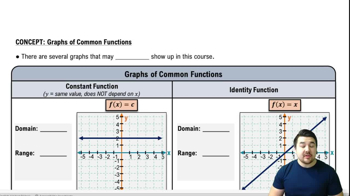
Graphs of Common Functions
Domain of a Relation
The domain is the set of all possible input values (x-values) for the relation. It includes every x-coordinate that appears on the graph, representing all values for which the relation is defined.
Recommended video:
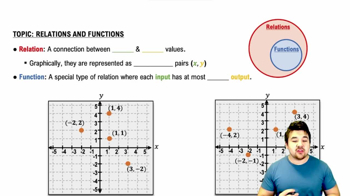
Relations and Functions
Range of a Relation
The range is the set of all possible output values (y-values) for the relation. It includes every y-coordinate that appears on the graph, representing all values the relation can produce.
Recommended video:
Relations and Functions
Watch next
Master Relations and Functions with a bite sized video explanation from Patrick
Start learningRelated Videos
Related Practice
Textbook Question
337
views