Simplify the radical expressions in Exercises 67–74, if possible. ³√150
Verified step by step guidance
1
Identify the type of radical expression: This is a cube root (³√) of 150. The goal is to simplify it by factoring the radicand (the number inside the radical) into its prime factors.
Perform prime factorization of 150: Break 150 into its prime factors. Start by dividing by the smallest prime numbers. For example, 150 = 2 × 3 × 5².
Group the factors into sets of three (since it is a cube root): Look for any factor that appears three times, as it can be taken out of the cube root. In this case, there are no factors that appear three times.
Simplify the expression: Since no factor appears three times, the cube root cannot be simplified further. The expression remains as ³√150.
Conclude the solution: State that the simplified form of the cube root of 150 is ³√150, as no further simplification is possible.
Verified video answer for a similar problem:
This video solution was recommended by our tutors as helpful for the problem above
Video duration:
2m
Play a video:
Was this helpful?
Key Concepts
Here are the essential concepts you must grasp in order to answer the question correctly.
Radical Expressions
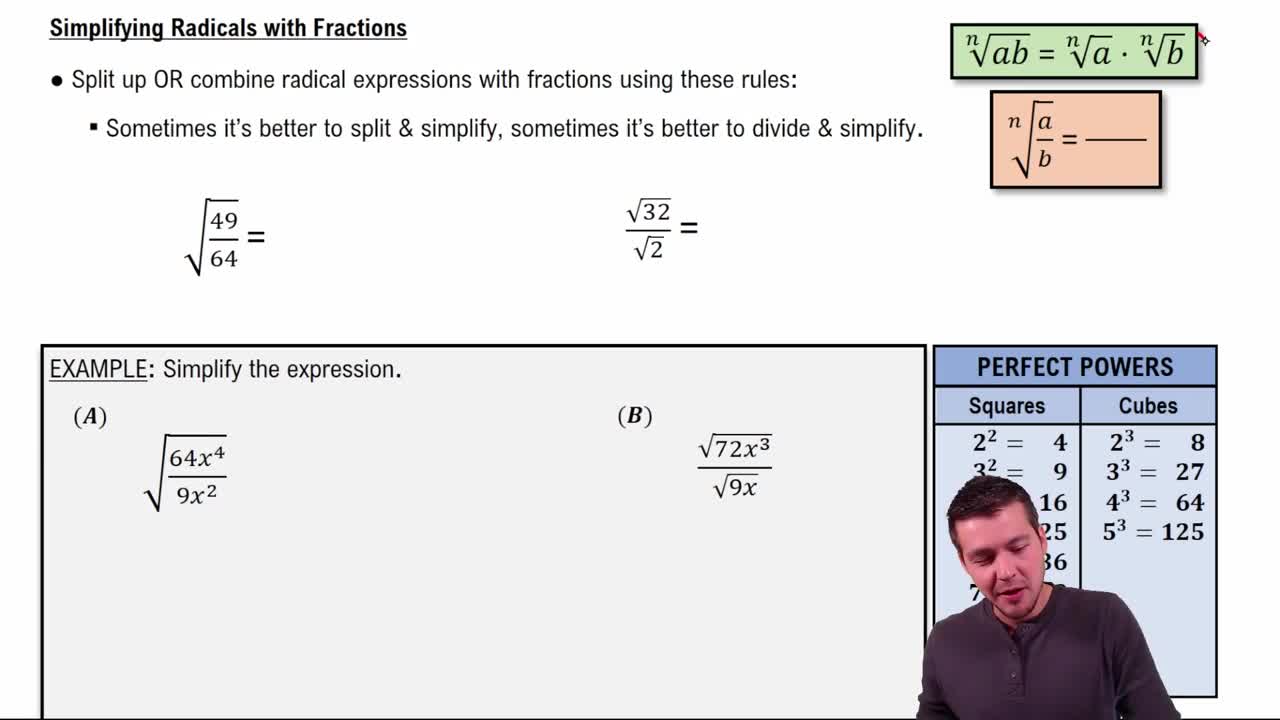
Radical expressions involve roots, such as square roots or cube roots. They can be simplified by factoring the radicand (the number inside the root) into its prime factors and identifying perfect powers. Understanding how to manipulate these expressions is crucial for simplification.
The cube root of a number is a value that, when multiplied by itself three times, gives the original number. For example, ³√8 = 2 because 2 × 2 × 2 = 8. Recognizing perfect cubes within the radicand helps in simplifying cube root expressions effectively.
Prime factorization is the process of breaking down a number into its prime factors. This technique is essential for simplifying radical expressions, as it allows one to identify and extract perfect squares or cubes from the radicand, facilitating the simplification process.