Use the intermediate value theorem to show that each polynomial function has a real zero between the numbers given. ƒ(x)=x4-4x3-x+3; 0.5 and 1
Table of contents
- 0. Review of Algebra4h 18m
- 1. Equations & Inequalities3h 18m
- 2. Graphs of Equations1h 43m
- 3. Functions2h 17m
- 4. Polynomial Functions1h 44m
- 5. Rational Functions1h 23m
- 6. Exponential & Logarithmic Functions2h 28m
- 7. Systems of Equations & Matrices4h 5m
- 8. Conic Sections2h 23m
- 9. Sequences, Series, & Induction1h 22m
- 10. Combinatorics & Probability1h 45m
4. Polynomial Functions
Understanding Polynomial Functions
Problem 56
Textbook Question
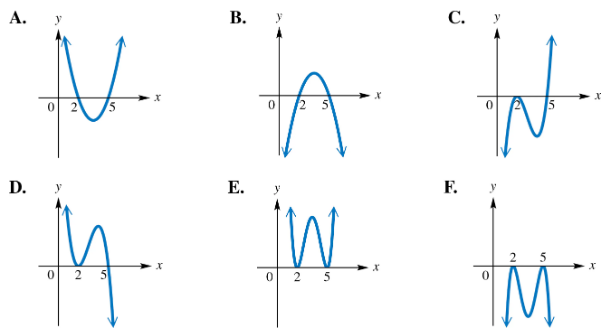
For each polynomial function, identify its graph from choices A–F.

Verified step by step guidance1
Start by identifying the zeros of the polynomial function ƒ(x) = (x-2)(x-5). The zeros are the values of x that make the function equal to zero. Set each factor equal to zero: x - 2 = 0 and x - 5 = 0.
Solve each equation to find the zeros: x = 2 and x = 5. These are the x-intercepts of the graph, meaning the graph crosses the x-axis at these points.
Determine the degree and leading coefficient of the polynomial. Since ƒ(x) is the product of two linear factors, it is a quadratic polynomial of degree 2. When expanded, the leading term will be \(x^2\), which has a positive coefficient.
Use the leading coefficient and degree to determine the end behavior of the graph. Because the leading coefficient is positive and the degree is even, the graph opens upwards on both ends.
Combine this information: the graph crosses the x-axis at x=2 and x=5, opens upwards, and is a parabola. Use these characteristics to match the function to the correct graph among choices A–F.
Verified video answer for a similar problem:This video solution was recommended by our tutors as helpful for the problem above
Video duration:
7mPlay a video:
Was this helpful?
Key Concepts
Here are the essential concepts you must grasp in order to answer the question correctly.
Polynomial Functions
A polynomial function is an expression consisting of variables and coefficients combined using addition, subtraction, and multiplication, with non-negative integer exponents. Understanding the general shape and behavior of polynomial functions helps in predicting their graphs.
Recommended video:
Introduction to Polynomial Functions
Roots or Zeros of a Polynomial
The roots or zeros of a polynomial are the values of x that make the function equal to zero. For ƒ(x) = (x-2)(x-5), the roots are x = 2 and x = 5, which correspond to the x-intercepts on the graph.
Recommended video:
Imaginary Roots with the Square Root Property
Graphing Polynomial Functions
Graphing involves plotting key points such as roots and determining the end behavior based on the leading term. For a quadratic like ƒ(x) = (x-2)(x-5), the graph is a parabola opening upwards, crossing the x-axis at the roots.
Recommended video:
Graphing Polynomial Functions
Watch next
Master Introduction to Polynomial Functions with a bite sized video explanation from Patrick
Start learningRelated Videos
Related Practice
Textbook Question
658
views