Evaluate the expression. *permutation notation* the number of permutations 8 things taken 3 at a time (sub 8)P(sub 3)
Table of contents
- 0. Review of Algebra4h 18m
- 1. Equations & Inequalities3h 18m
- 2. Graphs of Equations1h 43m
- 3. Functions2h 17m
- 4. Polynomial Functions1h 44m
- 5. Rational Functions1h 23m
- 6. Exponential & Logarithmic Functions2h 28m
- 7. Systems of Equations & Matrices4h 5m
- 8. Conic Sections2h 23m
- 9. Sequences, Series, & Induction1h 22m
- 10. Combinatorics & Probability1h 45m
10. Combinatorics & Probability
Combinatorics
Problem 14
Textbook Question
Use the formula for nCr to evaluate each expression. 4C4
Verified step by step guidance1
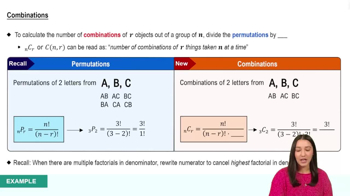
Recall the formula for combinations, which is used to find the number of ways to choose r objects from a set of n objects without regard to order: \[ \displaystyle {n \choose r} = \frac{n!}{r! (n-r)!} \]
Identify the values of n and r from the problem: here, \[ n = 4 \] and \[ r = 4 \].
Substitute the values of n and r into the combination formula: \[ \displaystyle {4 \choose 4} = \frac{4!}{4! (4-4)!} \].
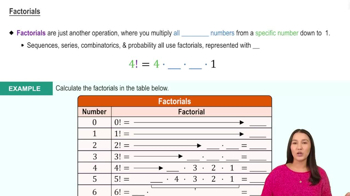
Simplify the factorial expressions in the denominator: \[ (4-4)! = 0! \], and recall that by definition, \[ 0! = 1 \].
Write the simplified expression ready for evaluation: \[ \displaystyle {4 \choose 4} = \frac{4!}{4! \times 1} \].
Was this helpful?
Key Concepts
Here are the essential concepts you must grasp in order to answer the question correctly.
Combination Formula (nCr)
The combination formula calculates the number of ways to choose r items from a set of n distinct items without regard to order. It is given by nCr = n! / [r! (n - r)!], where '!' denotes factorial. This formula is fundamental for solving problems involving selections or groups.
Recommended video:
Combinations
Factorial Function
A factorial, denoted by n!, is the product of all positive integers from 1 up to n. For example, 4! = 4 × 3 × 2 × 1 = 24. Factorials are used in permutations and combinations to count arrangements and selections systematically.
Recommended video:
Factorials
Evaluating Special Cases in Combinations
When r equals n in nCr, the combination equals 1 because there is exactly one way to choose all items from the set. Understanding these special cases helps simplify calculations and avoid unnecessary computation.
Recommended video:
Combinations
Watch next
Master Fundamental Counting Principle with a bite sized video explanation from Patrick
Start learningRelated Videos
Related Practice
Textbook Question
630
views