Write each number in standard form a+bi. 10+ √-200 / 5
Verified step by step guidance
1
Identify the expression given: \(\frac{10 + \sqrt{-200}}{5}\). Our goal is to write it in the form \(a + bi\), where \(a\) and \(b\) are real numbers.
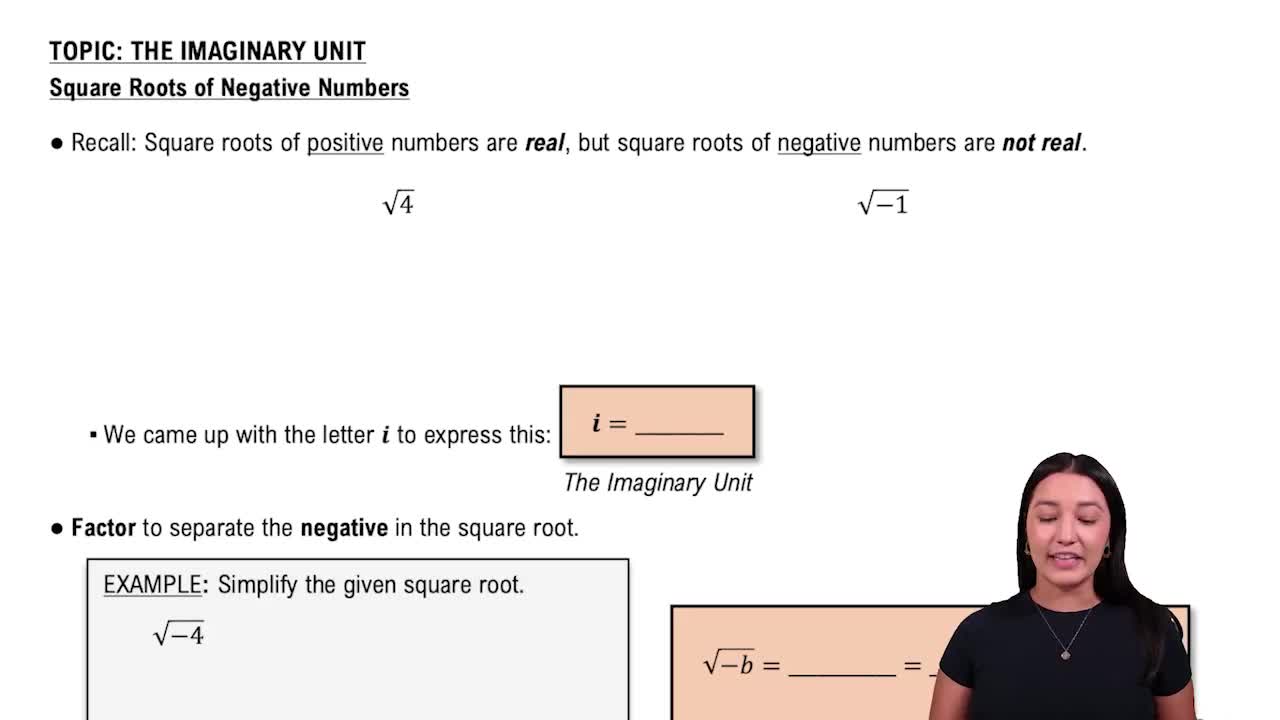
Simplify the square root of the negative number: \(\sqrt{-200} = \sqrt{200} \cdot \sqrt{-1} = \sqrt{200}i\). Recall that \(\sqrt{-1} = i\).
Simplify \(\sqrt{200}\) by factoring it into perfect squares: \(\sqrt{200} = \sqrt{100 \times 2} = \sqrt{100} \times \sqrt{2} = 10\sqrt{2}\).
Rewrite the numerator using the simplification: \$10 + 10\sqrt{2}i\(. Now the expression is \)\frac{10 + 10\sqrt{2}i}{5}$.
Divide both terms in the numerator by 5 separately: \(\frac{10}{5} + \frac{10\sqrt{2}i}{5} = 2 + 2\sqrt{2}i\). This is the standard form \(a + bi\).
Verified video answer for a similar problem:
This video solution was recommended by our tutors as helpful for the problem above
Video duration:
3m
Play a video:
Was this helpful?
Key Concepts
Here are the essential concepts you must grasp in order to answer the question correctly.
Complex Numbers and Standard Form
Complex numbers are expressed in the form a + bi, where a is the real part and b is the imaginary part. The imaginary unit i is defined as √-1. Writing a number in standard form means separating it into its real and imaginary components.
To simplify the square root of a negative number, factor out √-1 as i and simplify the remaining positive square root. For example, √-200 = √(200) * i = 10√2 * i. This step is essential to rewrite expressions involving imaginary numbers.
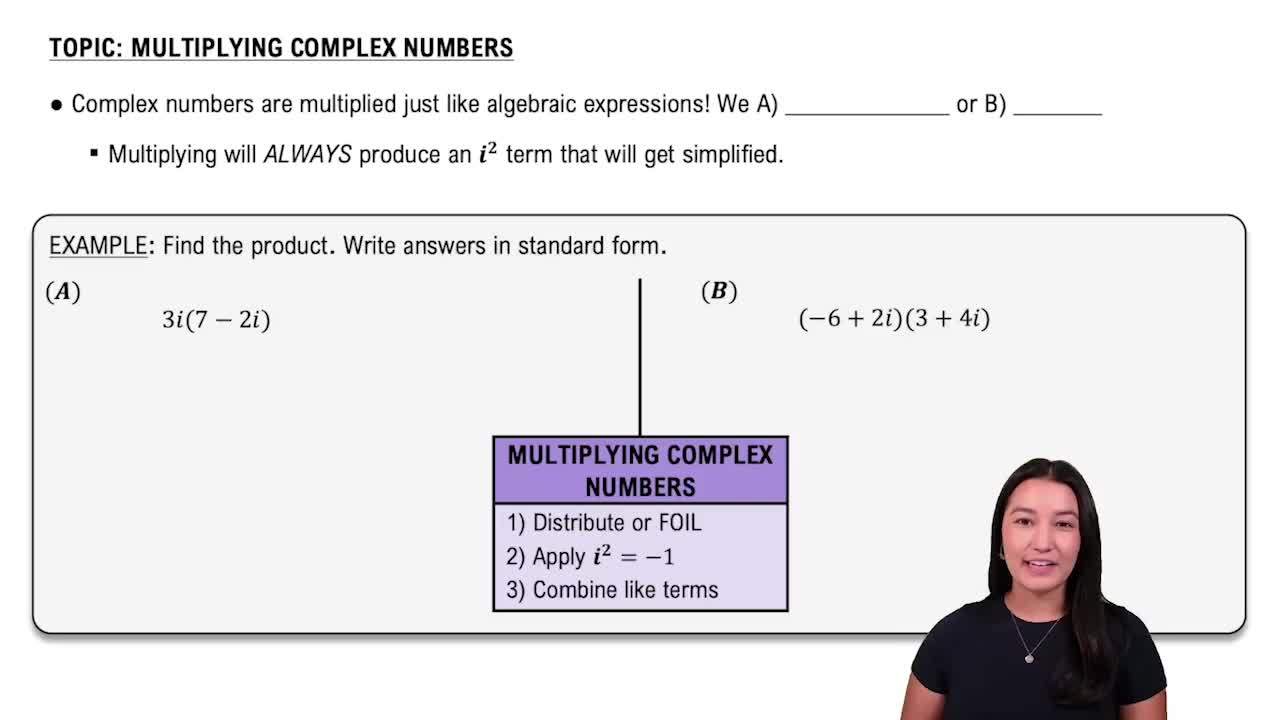
When performing arithmetic with complex numbers, apply algebraic rules carefully, including distributing division across terms and combining like terms. Simplify fractions and separate real and imaginary parts to express the result in standard form a + bi.