The sequences in Exercises 13–18 are defined using recursion formulas. Write the first four terms of each sequence. a1=7 and an=an-1 + 5 for n≥2
Table of contents
- 0. Review of Algebra4h 18m
- 1. Equations & Inequalities3h 18m
- 2. Graphs of Equations1h 43m
- 3. Functions2h 17m
- 4. Polynomial Functions1h 44m
- 5. Rational Functions1h 23m
- 6. Exponential & Logarithmic Functions2h 28m
- 7. Systems of Equations & Matrices4h 5m
- 8. Conic Sections2h 23m
- 9. Sequences, Series, & Induction1h 22m
- 10. Combinatorics & Probability1h 45m
9. Sequences, Series, & Induction
Sequences
Problem 21
Textbook Question
In Exercises 19–22, the general term of a sequence is given and involves a factorial. Write the first four terms of each sequence. an=2(n+1)!
Verified step by step guidance1
Understand the general term of the sequence given by \(a_n = 2(n+1)!\). Here, \((n+1)!\) means the factorial of \((n+1)\), which is the product of all positive integers from 1 up to \((n+1)\).
Recall that the factorial function is defined as \(k! = k \times (k-1) \times (k-2) \times \cdots \times 1\) for any positive integer \(k\), and \$0! = 1$ by definition.
To find the first four terms, substitute \(n = 1, 2, 3, 4\) into the formula \(a_n = 2(n+1)!\) one at a time.
Calculate each term step-by-step: for each \(n\), first compute \((n+1)!\), then multiply the result by 2 to get \(a_n\).
Write down the four terms in order: \(a_1\), \(a_2\), \(a_3\), and \(a_4\) as the first four terms of the sequence.
Verified video answer for a similar problem:This video solution was recommended by our tutors as helpful for the problem above
Video duration:
5mPlay a video:
Was this helpful?
Key Concepts
Here are the essential concepts you must grasp in order to answer the question correctly.
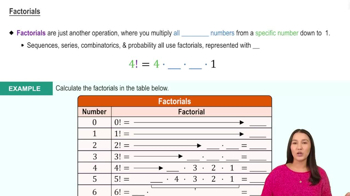
Factorials
A factorial, denoted by n!, is the product of all positive integers from 1 up to n. For example, 4! = 4 × 3 × 2 × 1 = 24. Factorials grow very quickly and are commonly used in sequences and combinatorics.
Recommended video:
Factorials
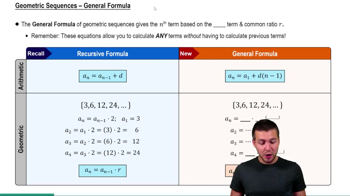
General Term of a Sequence
The general term a_n of a sequence defines the nth term as a function of n. It allows you to find any term in the sequence without listing all previous terms. For example, a_n = 2(n+1)! gives a formula to compute each term directly.
Recommended video:
Guided course
Geometric Sequences - General Formula
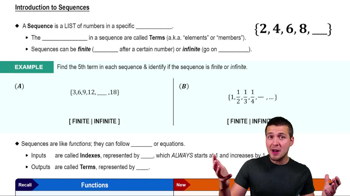
Evaluating Sequence Terms
To find specific terms of a sequence, substitute the term number n into the general term formula and simplify. For instance, to find the first four terms of a_n = 2(n+1)!, calculate a_1, a_2, a_3, and a_4 by plugging in n = 1, 2, 3, and 4.
Recommended video:
Guided course
Introduction to Sequences
Watch next
Master Introduction to Sequences with a bite sized video explanation from Patrick
Start learningRelated Videos
Related Practice
Textbook Question
744
views