For each polynomial function, use the remainder theorem to find ƒ(k).ƒ(x) = 2x^5 - 10x^3 - 19x^2 - 50; k=3
Verified step by step guidance
1
Identify the polynomial function \( f(x) = 2x^5 - 10x^3 - 19x^2 - 50 \) and the value \( k = 3 \).
According to the Remainder Theorem, the remainder of the division of \( f(x) \) by \( x - k \) is \( f(k) \).
Substitute \( k = 3 \) into the polynomial function: \( f(3) = 2(3)^5 - 10(3)^3 - 19(3)^2 - 50 \).
Calculate each term separately: \( 2(3)^5 \), \( -10(3)^3 \), \( -19(3)^2 \), and \( -50 \).
Add the results of the calculations from the previous step to find \( f(3) \).
Verified video answer for a similar problem:
This video solution was recommended by our tutors as helpful for the problem above
Video duration:
2m
Play a video:
Was this helpful?
Key Concepts
Here are the essential concepts you must grasp in order to answer the question correctly.
Polynomial Functions
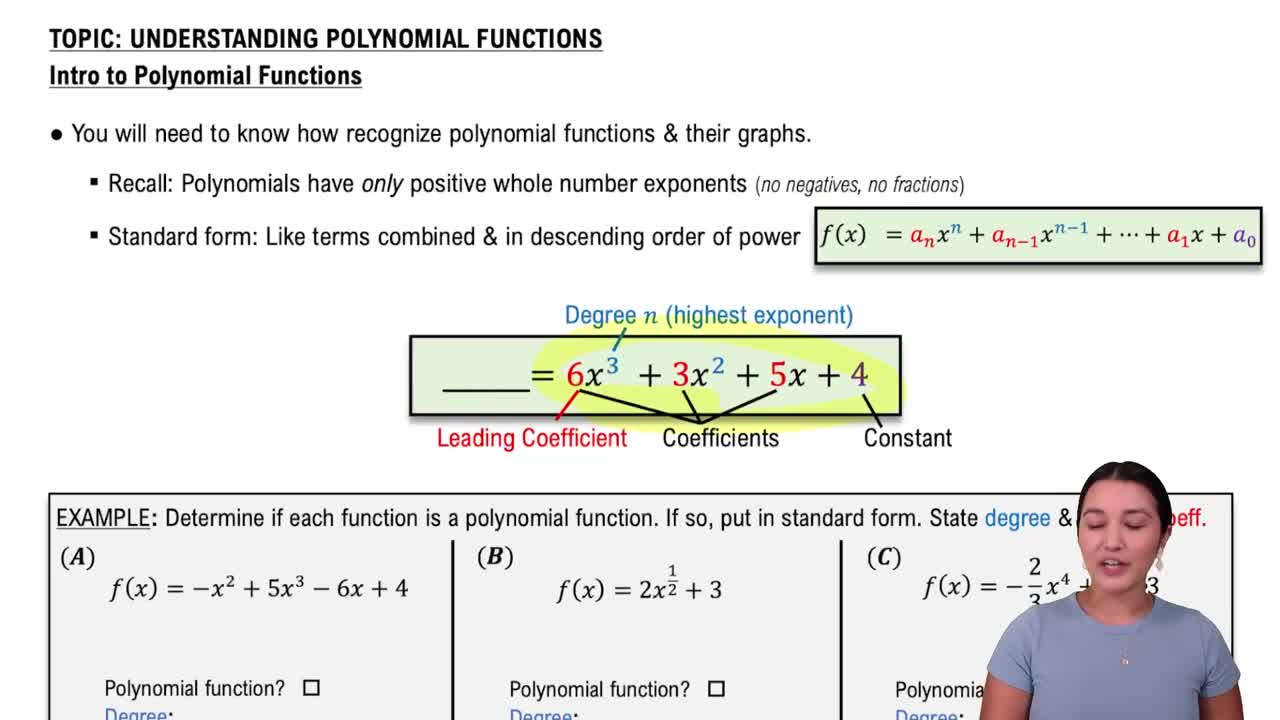
A polynomial function is a mathematical expression involving a sum of powers in one or more variables multiplied by coefficients. The general form of a polynomial in one variable is f(x) = a_n*x^n + a_(n-1)*x^(n-1) + ... + a_1*x + a_0, where n is a non-negative integer and a_n are constants. Understanding the structure of polynomial functions is essential for applying various theorems and methods in algebra.
The Remainder Theorem states that when a polynomial f(x) is divided by (x - k), the remainder of this division is equal to f(k). This theorem simplifies the process of evaluating polynomials at specific points, allowing for quick calculations without performing long division. It is particularly useful for finding function values and analyzing polynomial behavior.
Evaluating a function involves substituting a specific value into the function to determine its output. For polynomial functions, this means replacing the variable x with a given number, such as k in this case. Understanding how to evaluate functions is crucial for applying the Remainder Theorem and solving problems related to polynomial functions effectively.