Use synthetic division to divide f(x)=x3−4x2+x+6 by x+1. Use the result to find all zeros of f.
Verified step by step guidance
1
Identify the divisor and rewrite it in the form x - c. Since the divisor is x + 1, rewrite it as x - (-1), so c = -1.
Set up synthetic division by writing the coefficients of f(x) = x^3 - 4x^2 + x + 6 in order: 1, -4, 1, 6.
Perform synthetic division using c = -1: bring down the first coefficient, multiply by c, add to the next coefficient, and repeat for all coefficients.
Write the quotient polynomial from the synthetic division result. The degree of the quotient will be one less than the original polynomial.
Use the quotient polynomial and the remainder (if zero) to factor f(x). Then solve for zeros by setting each factor equal to zero, including the zero from the divisor x + 1.
Verified video answer for a similar problem:
This video solution was recommended by our tutors as helpful for the problem above
Video duration:
4m
Play a video:
Was this helpful?
Key Concepts
Here are the essential concepts you must grasp in order to answer the question correctly.
Synthetic Division
Synthetic division is a shortcut method for dividing a polynomial by a linear binomial of the form x - c. It simplifies the long division process by using only the coefficients of the polynomial, making calculations faster and less error-prone. This method helps find the quotient and remainder efficiently.
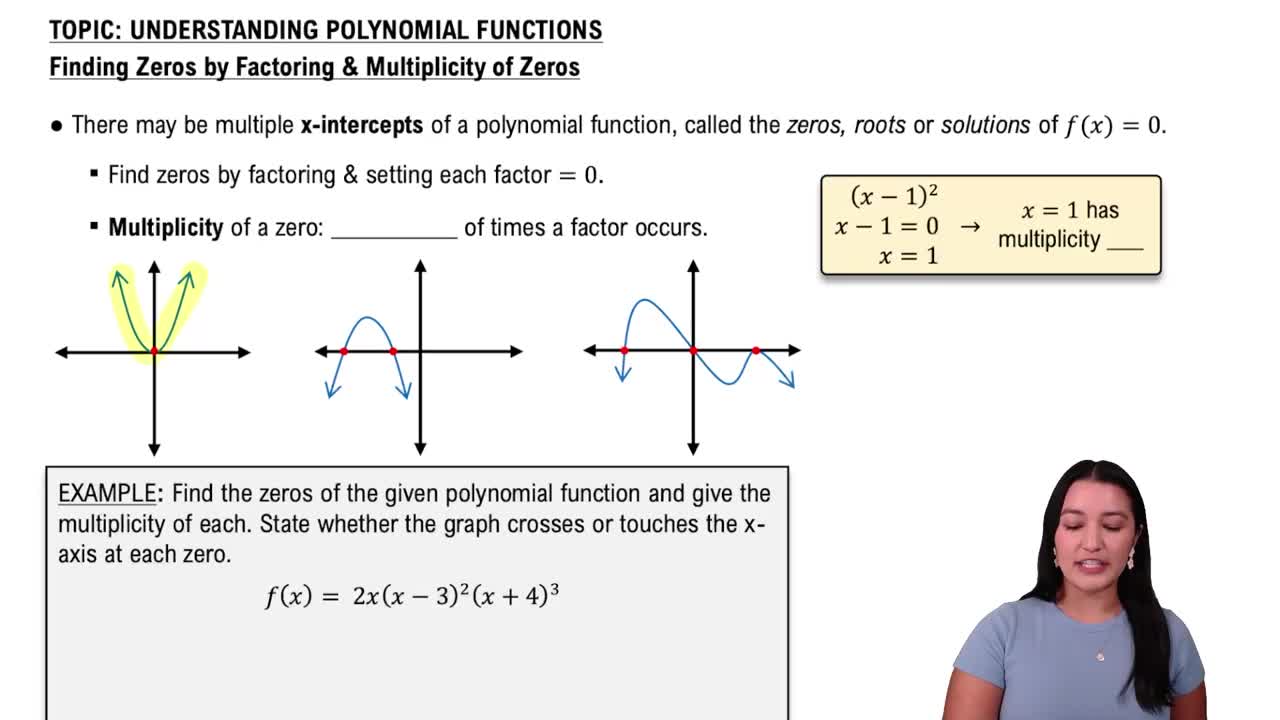
Zeros of a polynomial are the values of x that make the polynomial equal to zero. After division, the quotient polynomial can be further analyzed or factored to find additional zeros. Identifying zeros is essential for understanding the roots and graph of the polynomial function.
The Factor Theorem states that if a polynomial f(x) is divided by (x - c) and the remainder is zero, then (x - c) is a factor of f(x). This theorem connects synthetic division to finding zeros, as a zero of the polynomial corresponds to a factor of the form (x - c).