Use the various properties of exponential and logarithmic functions to evaluate the expressions in parts (a)–(c). Given g(x) = ex, find g(ln ln 52)
Table of contents
- 0. Review of Algebra4h 18m
- 1. Equations & Inequalities3h 18m
- 2. Graphs of Equations1h 43m
- 3. Functions2h 17m
- 4. Polynomial Functions1h 44m
- 5. Rational Functions1h 23m
- 6. Exponential & Logarithmic Functions2h 28m
- 7. Systems of Equations & Matrices4h 5m
- 8. Conic Sections2h 23m
- 9. Sequences, Series, & Induction1h 22m
- 10. Combinatorics & Probability1h 45m
6. Exponential & Logarithmic Functions
Properties of Logarithms
Problem 96b
Textbook Question
Use the various properties of exponential and logarithmic functions to evaluate the expressions in parts (a)–(c). Given ƒ(x) = 3x, find ƒ(log3 (ln 3))
Verified step by step guidance1
Identify the given function and the expression to evaluate: ƒ(x) = 3^x and we need to find ƒ(\log_3(\ln 3)).
Recall that ƒ(x) = 3^x means that when you input a value into ƒ, you raise 3 to the power of that value. So, ƒ(\log_3(\ln 3)) = 3^{\log_3(\ln 3)}.
Use the property of logarithms and exponents that states: for any positive a (a \neq 1), \ a^{\log_a(b)} = b. This means the base and the log base cancel out, leaving just the argument of the logarithm.
Apply this property to simplify 3^{\log_3(\ln 3)} to just \ln 3, because the base 3 and the log base 3 cancel out.
Conclude that ƒ(\log_3(\ln 3)) simplifies to \ln 3, which is the natural logarithm of 3.
Verified video answer for a similar problem:This video solution was recommended by our tutors as helpful for the problem above
Video duration:
1mPlay a video:
Was this helpful?
Key Concepts
Here are the essential concepts you must grasp in order to answer the question correctly.
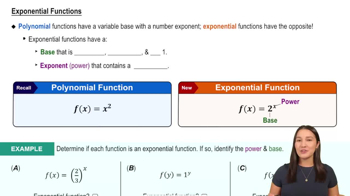
Exponential Functions
An exponential function has the form f(x) = a^x, where the base a is a positive constant not equal to 1. It models growth or decay processes and has properties such as f(0) = 1 and continuous increase or decrease depending on the base.
Recommended video:
Exponential Functions
Logarithmic Functions and Their Properties
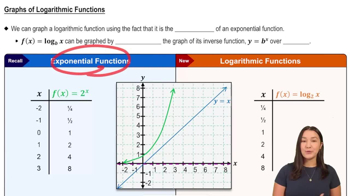
A logarithmic function is the inverse of an exponential function, defined as log_a(x), which answers the question: to what power must a be raised to get x? Key properties include log_a(a^x) = x and a^{log_a(x)} = x, which help simplify expressions involving logs and exponents.
Recommended video:
Graphs of Logarithmic Functions
Composition of Functions and Inverse Relationships
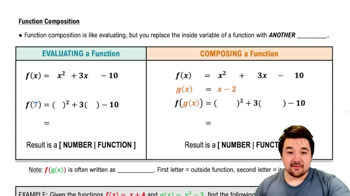
Composing functions involves applying one function to the result of another, such as f(g(x)). When dealing with exponential and logarithmic functions, their inverse relationship means that applying one after the other can simplify expressions, e.g., a^{log_a(x)} = x, which is essential for evaluating the given expression.
Recommended video:
Function Composition
Watch next
Master Product, Quotient, and Power Rules of Logs with a bite sized video explanation from Patrick
Start learningRelated Videos
Related Practice
Textbook Question
560
views