In Exercises 91–100, find all values of x satisfying the given conditions.
Table of contents
- 0. Review of Algebra4h 18m
- 1. Equations & Inequalities3h 18m
- 2. Graphs of Equations1h 43m
- 3. Functions2h 17m
- 4. Polynomial Functions1h 44m
- 5. Rational Functions1h 23m
- 6. Exponential & Logarithmic Functions2h 28m
- 7. Systems of Equations & Matrices4h 5m
- 8. Conic Sections2h 23m
- 9. Sequences, Series, & Induction1h 22m
- 10. Combinatorics & Probability1h 45m
0. Review of Algebra
Rational Exponents
Problem 106
Textbook Question
Solve each equation for the specified variable. (Assume all denominators are nonzero.) x2/3+y2/3=a2/3, for y
Verified step by step guidance1
Start with the given equation: \(x^{2\/3} + y^{2\/3} = a^{2\/3}\).
Isolate the term containing \(y\) by subtracting \(x^{2\/3}\) from both sides: \(y^{2\/3} = a^{2\/3} - x^{2\/3}\).
To solve for \(y\), raise both sides of the equation to the power that is the reciprocal of \(\frac{2}{3}\), which is \(\frac{3}{2}\), to undo the fractional exponent on \(y\): \(\left(y^{2\/3}\right)^{3\/2} = \left(a^{2\/3} - x^{2\/3}\right)^{3\/2}\).
Simplify the left side using the property \((b^{m})^{n} = b^{m \cdot n}\), so \(y^{(2\/3) \cdot (3\/2)} = y^{1} = y\).
Write the final expression for \(y\): \(y = \left(a^{2\/3} - x^{2\/3}\right)^{3\/2}\).
Verified video answer for a similar problem:This video solution was recommended by our tutors as helpful for the problem above
Video duration:
2mPlay a video:
Was this helpful?
Key Concepts
Here are the essential concepts you must grasp in order to answer the question correctly.
Fractional Exponents
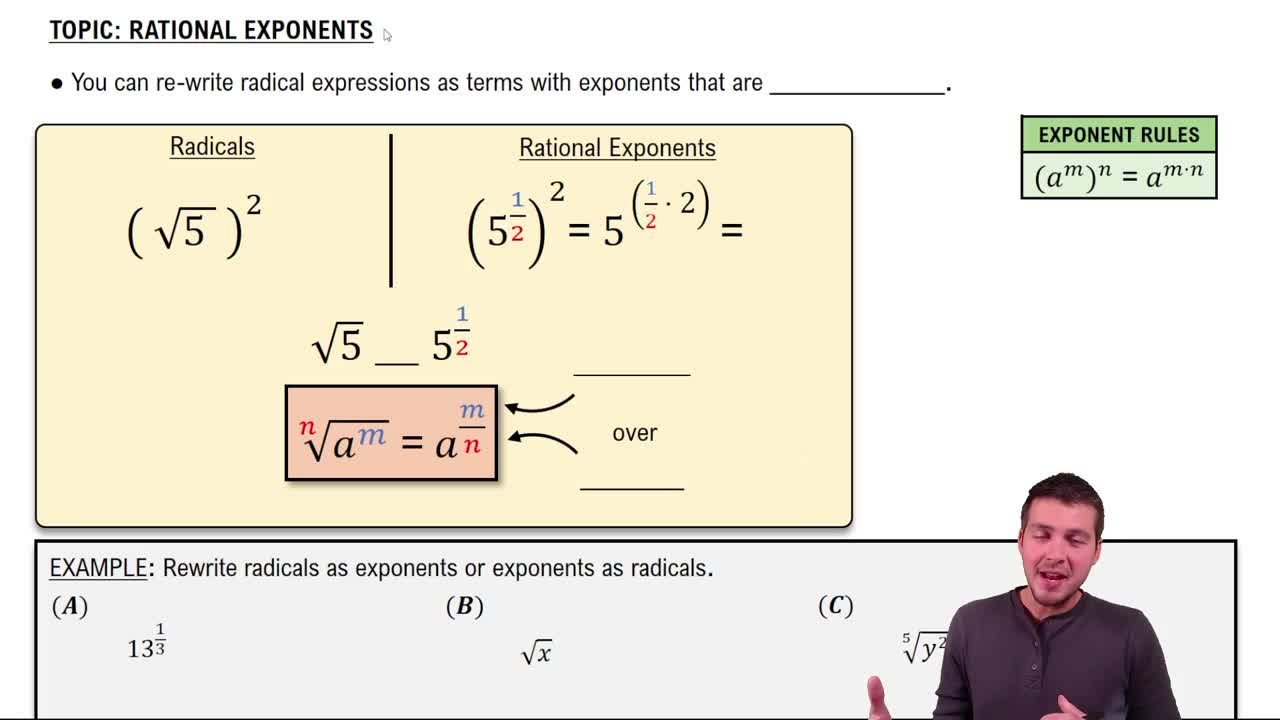
Fractional exponents represent roots and powers simultaneously. For example, x^(2/3) means the cube root of x squared, or (x^2)^(1/3). Understanding how to manipulate and invert fractional exponents is essential for isolating variables in equations involving them.
Recommended video:
Guided course
Rational Exponents
Isolating Variables in Equations
Isolating a variable involves rearranging the equation to express that variable explicitly on one side. This often requires inverse operations such as taking roots or powers, especially when variables are raised to fractional exponents, to solve for the specified variable.
Recommended video:
Guided course
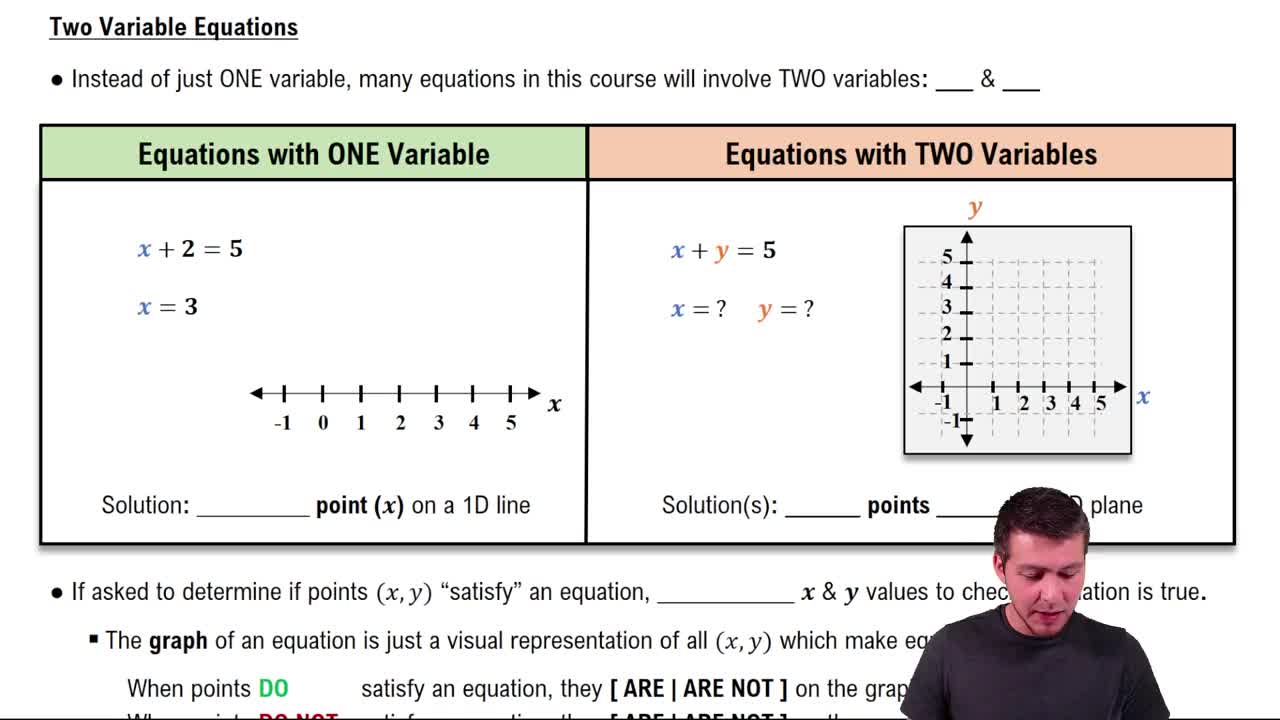
Equations with Two Variables
Domain Restrictions and Nonzero Denominators
When solving equations with fractional exponents, it is important to consider domain restrictions to avoid undefined expressions, such as division by zero or even roots of negative numbers. The problem states denominators are nonzero, ensuring valid operations during manipulation.
Recommended video:
Guided course
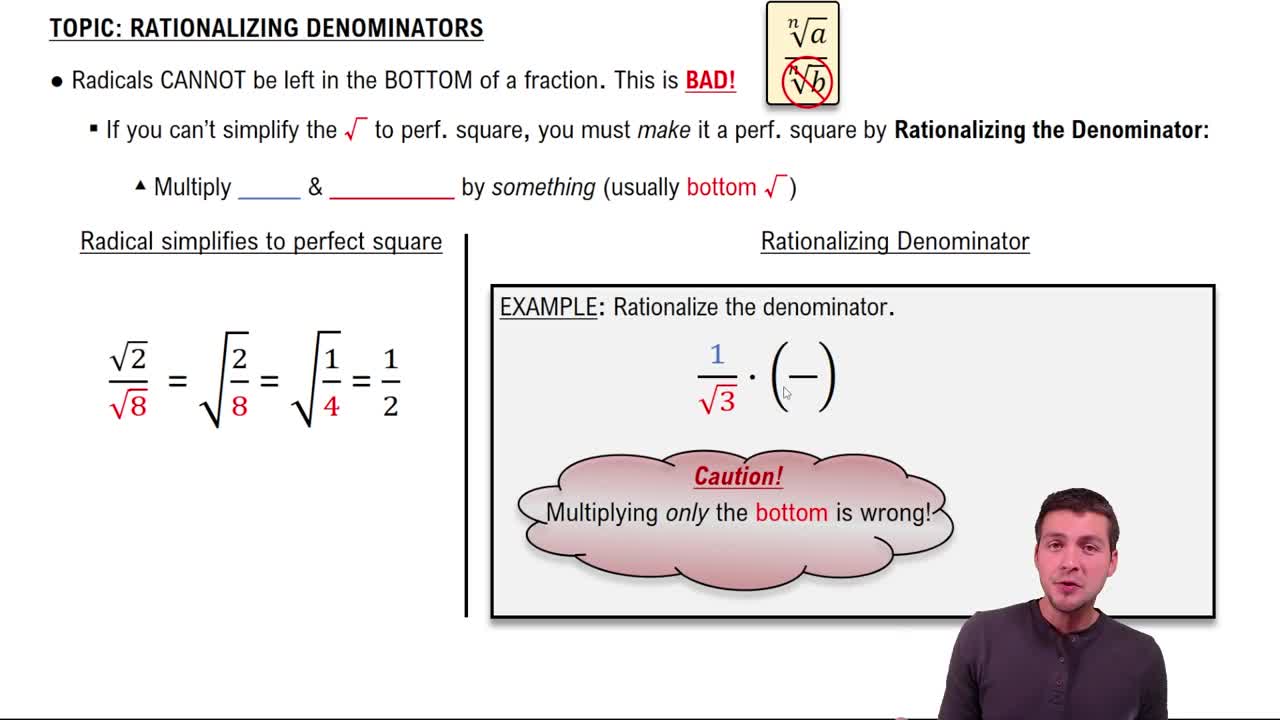
Rationalizing Denominators
Related Videos
Related Practice
Textbook Question
434
views