Use the rules for radicals to perform the indicated operations. Assume all variable expressions represent positive real numbers. ∜∛2
Verified step by step guidance
1
Identify the expression: you have the fourth root of the cube root of 2, which can be written as \(\sqrt[4]{\sqrt[3]{2}}\).
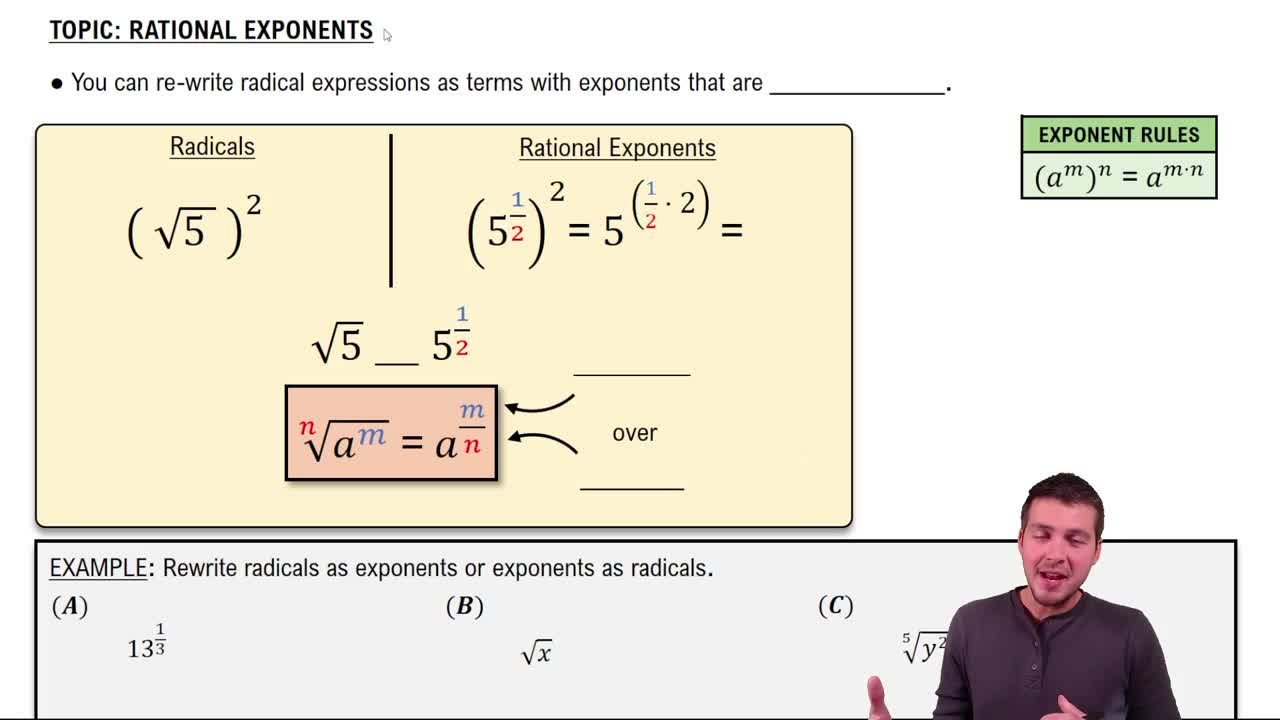
Rewrite the nested radicals using fractional exponents: recall that \(\sqrt[n]{a} = a^{\frac{1}{n}}\). So, \(\sqrt[3]{2} = 2^{\frac{1}{3}}\) and \(\sqrt[4]{\sqrt[3]{2}} = \left(2^{\frac{1}{3}}\right)^{\frac{1}{4}}\).
Apply the power of a power rule: when raising a power to another power, multiply the exponents. So, \(\left(2^{\frac{1}{3}}\right)^{\frac{1}{4}} = 2^{\frac{1}{3} \times \frac{1}{4}}\).
Multiply the exponents: \(\frac{1}{3} \times \frac{1}{4} = \frac{1}{12}\), so the expression simplifies to \$2^{\frac{1}{12}}$.
Rewrite the result back into radical form if desired: \$2^{\frac{1}{12}} = \sqrt[12]{2}$, which is the twelfth root of 2.
Verified video answer for a similar problem:
This video solution was recommended by our tutors as helpful for the problem above
Video duration:
58s
Play a video:
Was this helpful?
Key Concepts
Here are the essential concepts you must grasp in order to answer the question correctly.
Radical Expressions and Their Notation
Radical expressions involve roots such as square roots, cube roots, and fourth roots, denoted by the radical symbol with an index indicating the root degree. For example, ∜ represents the fourth root and ∛ the cube root. Understanding how to read and interpret these symbols is essential for manipulating and simplifying radical expressions.
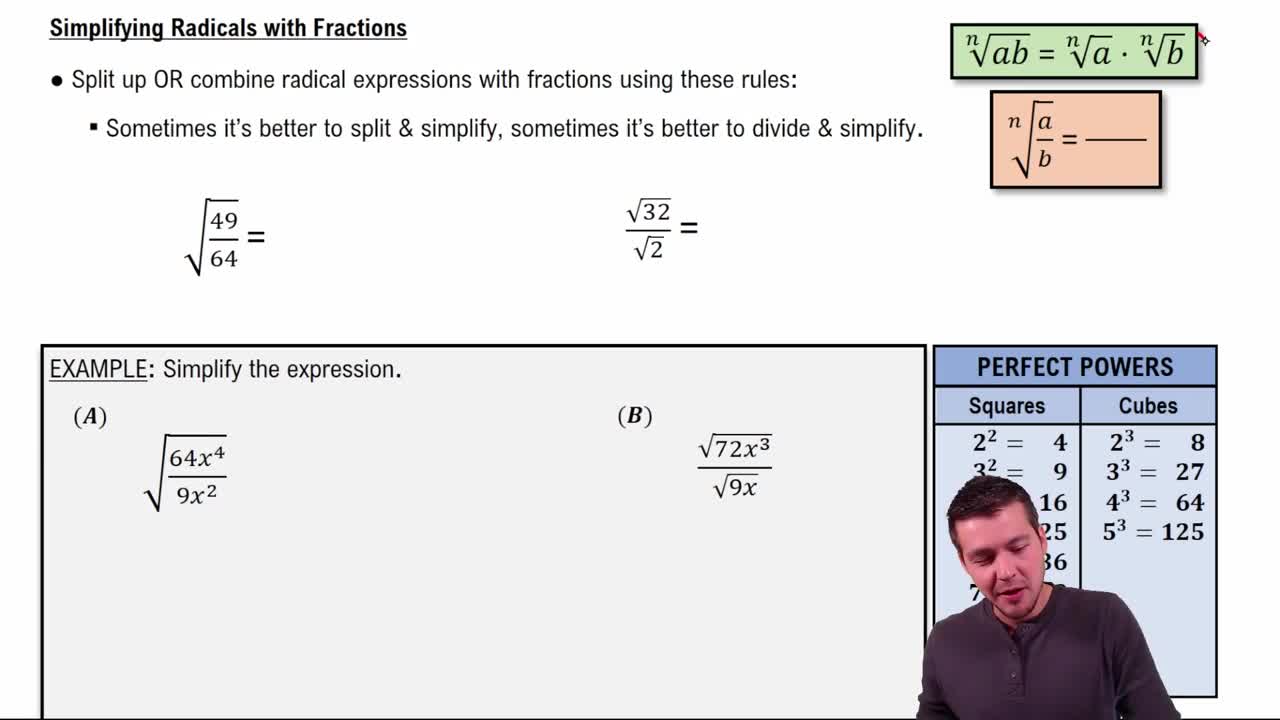
The rules for radicals include product, quotient, and power rules, which allow simplification and combination of radicals. For instance, the product rule states that the nth root of a product equals the product of the nth roots. These rules help in rewriting and simplifying expressions involving multiple radicals.
Radicals can be expressed as rational exponents, where the nth root of a number is the same as raising that number to the power of 1/n. For example, ∜(∛2) can be rewritten as 2 raised to the power of (1/3)*(1/4) = 1/12. This conversion simplifies operations like multiplication and exponentiation of radicals.