Use the rules for radicals to perform the indicated operations. Assume all variable expressions represent positive real numbers. ⁵√∛9
Verified step by step guidance
1
First, understand the expression: ⁵√∛9. This means we are dealing with a composition of radicals, specifically a fifth root and a cube root.
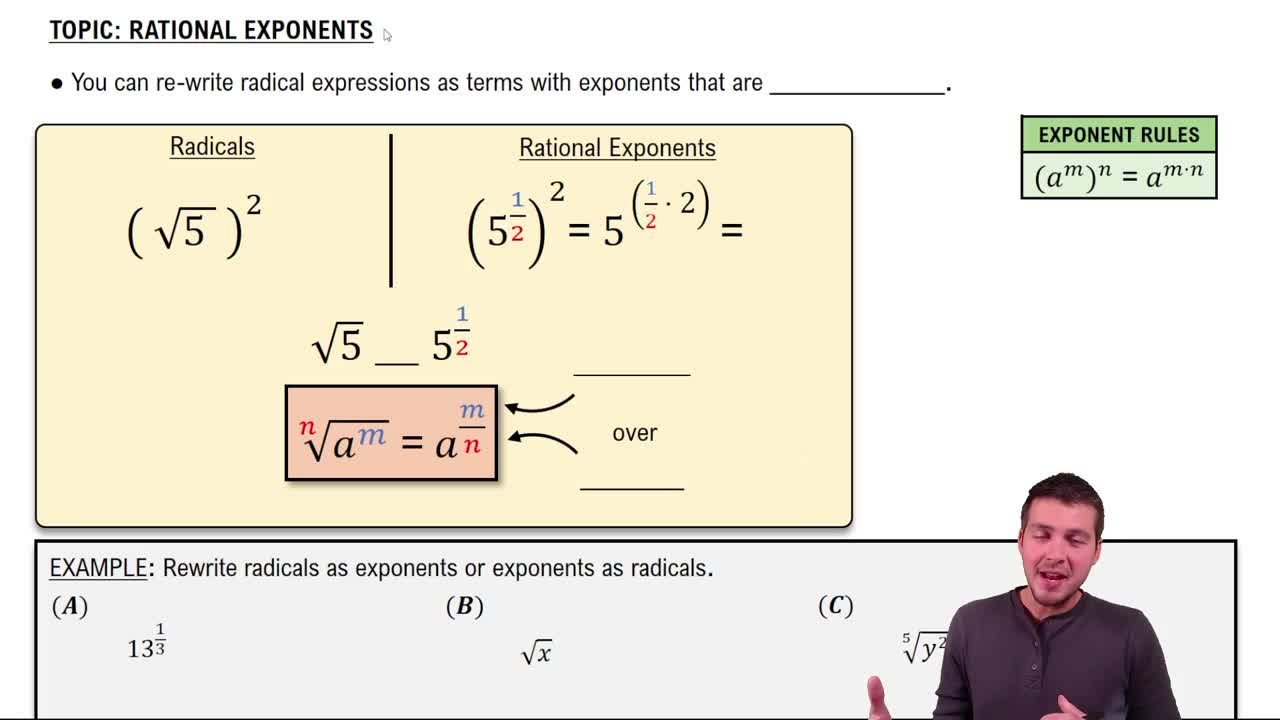
Rewrite the expression using rational exponents: ⁵√∛9 can be expressed as \((9^{1/3})^{1/5}\).
Apply the property of exponents \((a^m)^n = a^{m \cdot n}\) to combine the exponents: \((9^{1/3})^{1/5} = 9^{(1/3) \cdot (1/5)}\).
Calculate the product of the exponents: \(1/3 \cdot 1/5 = 1/15\).
Rewrite the expression with the new exponent: \(9^{1/15}\). This is the simplified form of the original expression.
Verified video answer for a similar problem:
This video solution was recommended by our tutors as helpful for the problem above
Video duration:
1m
Play a video:
Was this helpful?
Key Concepts
Here are the essential concepts you must grasp in order to answer the question correctly.
Radical Expressions
Radical expressions involve roots, such as square roots, cube roots, and higher-order roots. They are represented using the radical symbol (√) or fractional exponents. Understanding how to manipulate these expressions is crucial for performing operations like addition, subtraction, multiplication, and division involving radicals.
The properties of exponents govern how to simplify expressions involving powers and roots. Key rules include the product of powers, quotient of powers, and power of a power. These properties are essential when converting between radical and exponential forms, especially when dealing with multiple roots.
Simplifying radicals involves reducing radical expressions to their simplest form. This includes factoring out perfect squares or cubes from under the radical sign and rewriting the expression using exponents. Mastery of this concept allows for easier computation and clearer expression of radical values.