Explain why it is not possible for a hyperbola to have foci at (0,-2) and (0,2) and vertices at (0,-3) and (0,3).
Table of contents
- 0. Review of Algebra4h 18m
- 1. Equations & Inequalities3h 18m
- 2. Graphs of Equations1h 43m
- 3. Functions2h 17m
- 4. Polynomial Functions1h 44m
- 5. Rational Functions1h 23m
- 6. Exponential & Logarithmic Functions2h 28m
- 7. Systems of Equations & Matrices4h 5m
- 8. Conic Sections2h 23m
- 9. Sequences, Series, & Induction1h 22m
- 10. Combinatorics & Probability1h 45m
8. Conic Sections
Hyperbolas NOT at the Origin
Problem 17
Textbook Question
Use vertices and asymptotes to graph each hyperbola. Locate the foci and find the equations of the asymptotes. y2/16−x2/36=1
Verified step by step guidance1
Identify the standard form of the hyperbola equation. The given equation is \(\frac{y^2}{16} - \frac{x^2}{36} = 1\), which matches the form \(\frac{y^2}{a^2} - \frac{x^2}{b^2} = 1\). This means the hyperbola opens vertically (up and down).
Determine the values of \(a\) and \(b\) by comparing denominators: \(a^2 = 16\) so \(a = 4\), and \(b^2 = 36\) so \(b = 6\). The vertices are located at \((0, \pm a)\), which means \((0, \pm 4)\).
Find the foci using the relationship \(c^2 = a^2 + b^2\). Calculate \(c\) by \(c = \sqrt{16 + 36} = \sqrt{52}\). The foci are at \((0, \pm c)\), or \((0, \pm \sqrt{52})\).
Write the equations of the asymptotes. For a hyperbola of the form \(\frac{y^2}{a^2} - \frac{x^2}{b^2} = 1\), the asymptotes are given by \(y = \pm \frac{a}{b} x\). Substitute \(a = 4\) and \(b = 6\) to get \(y = \pm \frac{4}{6} x\).
Summarize the key features: vertices at \((0, \pm 4)\), foci at \((0, \pm \sqrt{52})\), and asymptotes \(y = \pm \frac{2}{3} x\). Use these to sketch the hyperbola, plotting vertices and foci, then drawing the asymptotes as guide lines.
Verified video answer for a similar problem:This video solution was recommended by our tutors as helpful for the problem above
Video duration:
10mPlay a video:
Was this helpful?
Key Concepts
Here are the essential concepts you must grasp in order to answer the question correctly.
Standard Form of a Hyperbola
A hyperbola's equation in standard form is either (y²/a²) - (x²/b²) = 1 or (x²/a²) - (y²/b²) = 1. This form helps identify the orientation (vertical or horizontal) of the hyperbola, the lengths of its transverse and conjugate axes, and the locations of its vertices and center.
Recommended video:
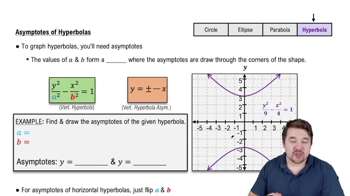
Asymptotes of Hyperbolas
Foci of a Hyperbola
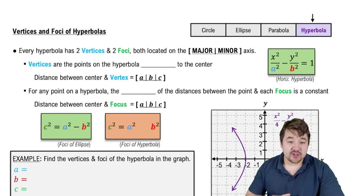
The foci are two fixed points located along the transverse axis of the hyperbola, used to define the curve. Their distance from the center is given by c, where c² = a² + b². Finding the foci helps in understanding the shape and properties of the hyperbola.
Recommended video:
Foci and Vertices of Hyperbolas
Equations of the Asymptotes
Asymptotes are lines that the hyperbola approaches but never touches. For a hyperbola centered at the origin, the asymptotes have equations y = ±(a/b)x or y = ±(b/a)x depending on orientation. These lines guide the graphing of the hyperbola and indicate its end behavior.
Recommended video:
Introduction to Asymptotes
Watch next
Master Graph Hyperbolas NOT at the Origin with a bite sized video explanation from Patrick
Start learningRelated Videos
Related Practice
Textbook Question
831
views