Perform the indicated operations and/or simplify each expression. Assume all variables represent positive real numbers.
Verified step by step guidance
1
Rewrite each cube root expression using fractional exponents: \(\sqrt[3]{mn} = (mn)^{1/3}\), \(\sqrt[3]{m^2} = m^{2/3}\), and \(\sqrt[3]{n^2} = n^{2/3}\).
Express the numerator as a product of powers: \((mn)^{1/3} \cdot m^{2/3} = m^{1/3} n^{1/3} \cdot m^{2/3}\).
Combine the powers of \(m\) in the numerator by adding the exponents: \(m^{1/3} \cdot m^{2/3} = m^{(1/3 + 2/3)} = m^{1}\), so the numerator becomes \(m^{1} n^{1/3}\).
Write the entire expression as a single fraction with exponents: \(\frac{m^{1} n^{1/3}}{n^{2/3}}\).
Simplify the powers of \(n\) by subtracting the exponents in the denominator from those in the numerator: \(n^{1/3 - 2/3} = n^{-1/3}\), so the expression simplifies to \(m^{1} n^{-1/3}\), which can also be written as \(\frac{m}{\sqrt[3]{n}}\).
Verified video answer for a similar problem:
This video solution was recommended by our tutors as helpful for the problem above
Video duration:
3m
Play a video:
Was this helpful?
Key Concepts
Here are the essential concepts you must grasp in order to answer the question correctly.
Properties of Radicals
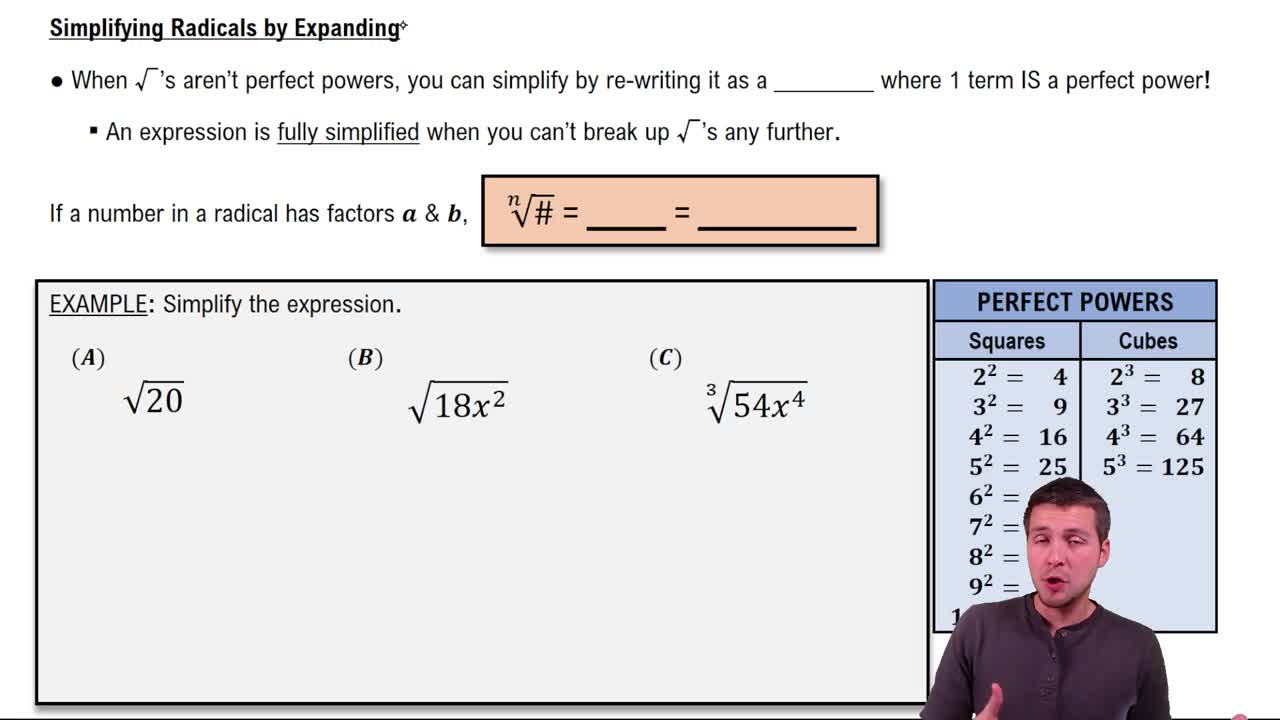
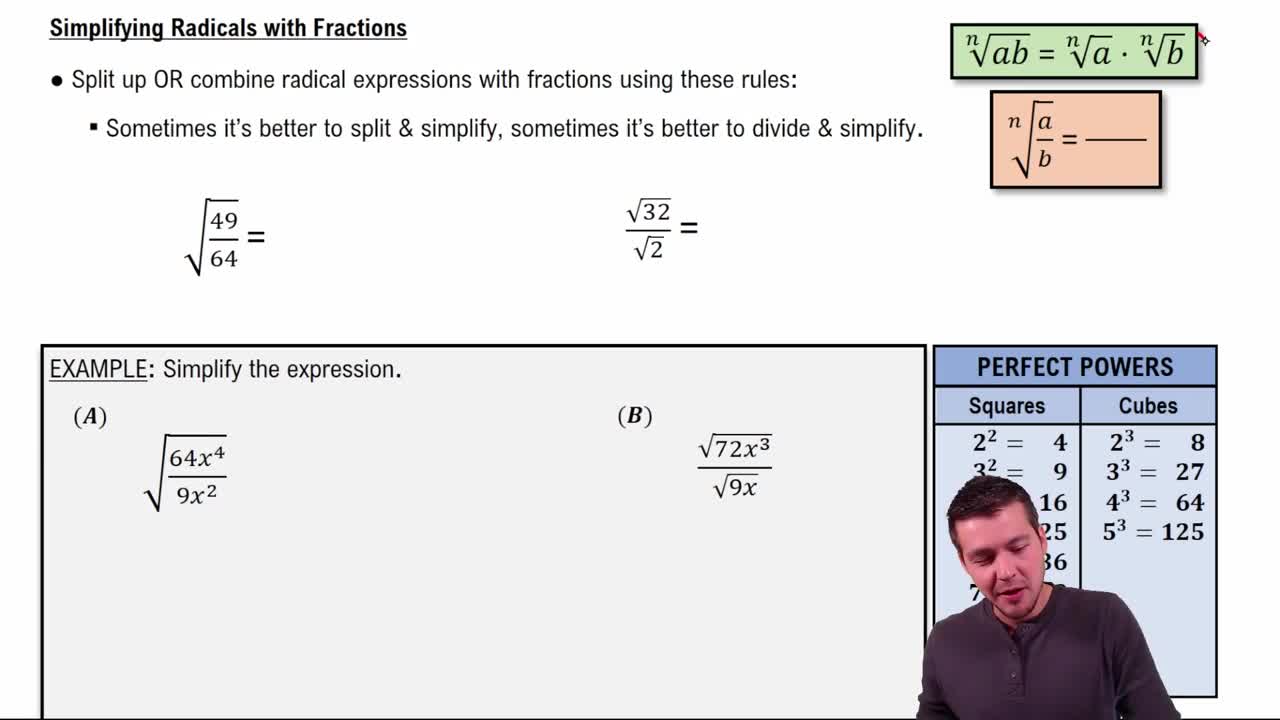
Radicals represent roots, such as cube roots (∛). Key properties include that the product of roots can be combined under a single root if they have the same index, e.g., ∛a * ∛b = ∛(ab). Understanding these properties allows simplification of expressions involving multiple radicals.
Simplifying radicals involves rewriting expressions to their simplest form by factoring and reducing powers inside the root. For example, variables with exponents can be manipulated using root and exponent rules to combine or reduce terms under the radical.
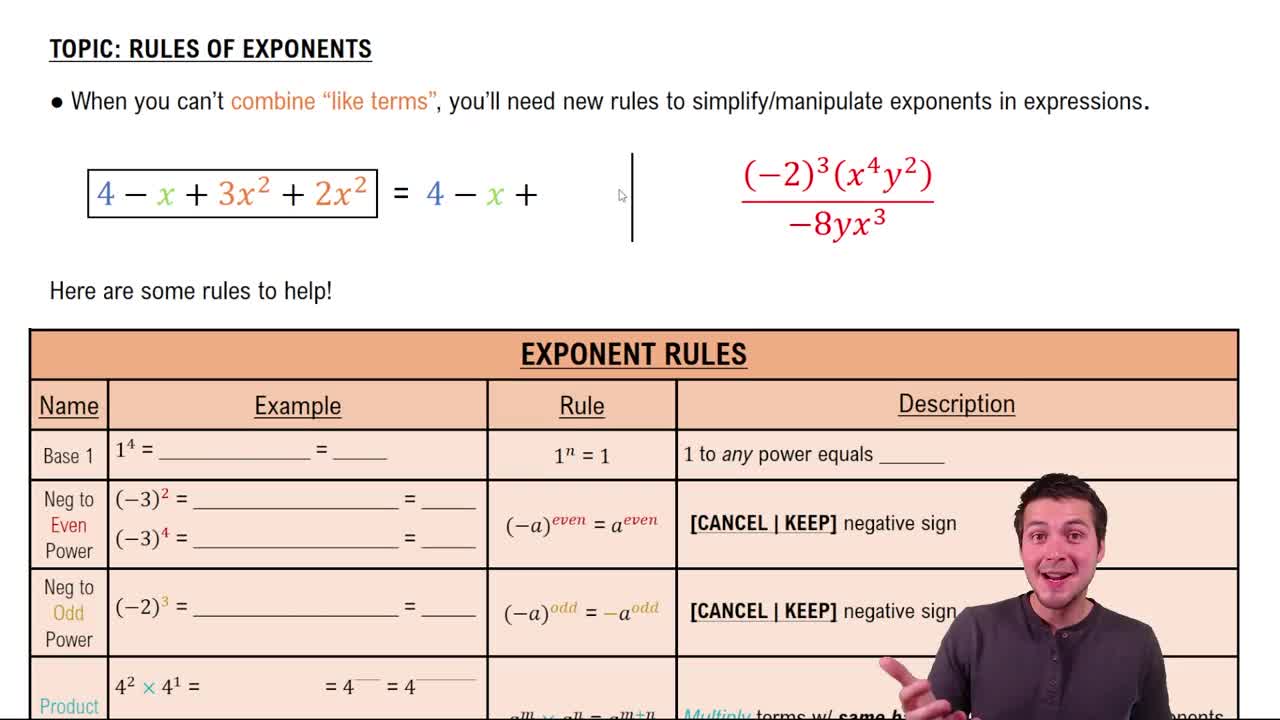
Radicals can be expressed as fractional exponents, such as ∛x = x^(1/3). Using exponent rules, like multiplying powers when bases are the same and dividing powers when dividing like bases, helps simplify complex radical expressions efficiently.