Table of contents
- 0. Review of Algebra4h 18m
- 1. Equations & Inequalities3h 18m
- 2. Graphs of Equations1h 43m
- 3. Functions2h 17m
- 4. Polynomial Functions1h 44m
- 5. Rational Functions1h 23m
- 6. Exponential & Logarithmic Functions2h 28m
- 7. Systems of Equations & Matrices4h 5m
- 8. Conic Sections2h 23m
- 9. Sequences, Series, & Induction1h 22m
- 10. Combinatorics & Probability1h 45m
0. Review of Algebra
Radical Expressions
Problem 135
Textbook Question
Perform the indicated operations and/or simplify each expression. Assume all variables represent positive real numbers.
Verified step by step guidance1
Rewrite the expression using exponents instead of radicals. Recall that the square root of a variable is the same as raising it to the power of 1/2. So, rewrite \(\sqrt{x^{5} y^{3}}\) as \((x^{5} y^{3})^{\frac{1}{2}}\).
Apply the power of a product rule: \((ab)^m = a^m b^m\). This means \((x^{5} y^{3})^{\frac{1}{2}} = x^{5 \cdot \frac{1}{2}} y^{3 \cdot \frac{1}{2}}\).
Simplify the exponents by multiplying: \(x^{\frac{5}{2}} y^{\frac{3}{2}}\).
Rewrite the entire expression as \(\frac{x^{\frac{5}{2}} y^{\frac{3}{2}}}{z^{2}}\) since the denominator \(z^{2}\) remains unchanged.
Check if any further simplification is possible by expressing fractional exponents as radicals or by factoring exponents, depending on the context or instructions.
Verified video answer for a similar problem:This video solution was recommended by our tutors as helpful for the problem above
Video duration:
3mPlay a video:
Was this helpful?
Key Concepts
Here are the essential concepts you must grasp in order to answer the question correctly.
Properties of Exponents
Understanding how to manipulate exponents is essential for simplifying expressions. This includes rules like multiplying powers with the same base, dividing powers, and raising powers to powers. For example, x^a / x^b = x^(a-b) and (x^a)^b = x^(ab).
Recommended video:
Guided course
Rational Exponents
Simplifying Radicals
Simplifying radicals involves expressing the radicand as a product of perfect squares (or higher powers) and other factors to simplify the root. For example, √(x⁵) can be rewritten as x²√x by separating powers into even and odd exponents.
Recommended video:
Guided course
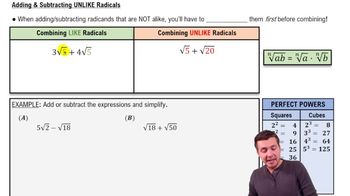
Adding & Subtracting Unlike Radicals by Simplifying
Division of Expressions with Variables
When dividing expressions with variables, apply exponent rules to subtract exponents of like bases in numerator and denominator. Also, keep track of variables under radicals and outside to simplify the entire expression correctly.
Recommended video:
Guided course
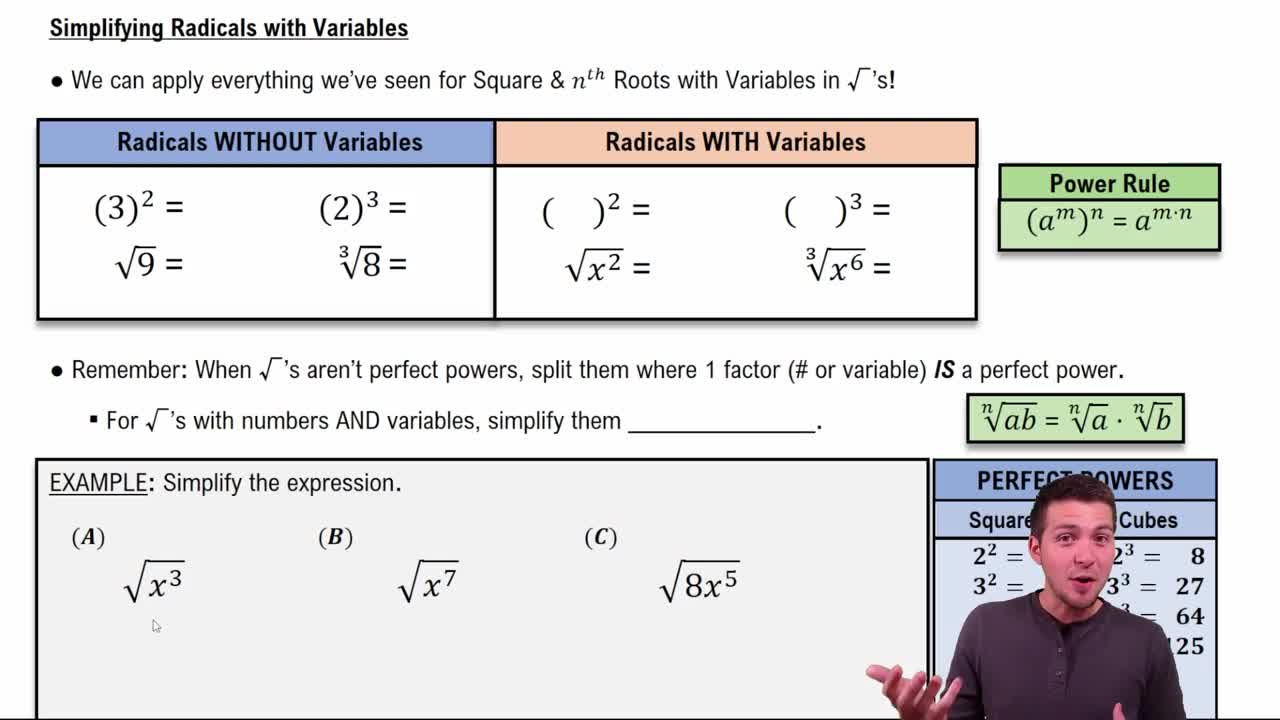
Radical Expressions with Variables
Related Videos
Related Practice
Textbook Question
Between which two consecutive integers is -√26? Do not use a calculator.
672
views