Without actually graphing, identify the type of graph that each equation has. 16(x+3)2+16(y−2)2=1
Verified step by step guidance
1
Observe the given equation: \(\frac{\left(x+3\right)^2}{16} + \frac{\left(y-2\right)^2}{16} = 1\).
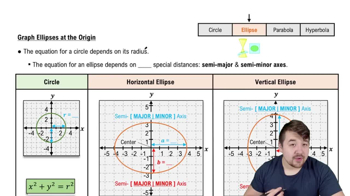
Recognize that this equation is in the standard form of an ellipse centered at \((-3, 2)\), which is \(\frac{(x-h)^2}{a^2} + \frac{(y-k)^2}{b^2} = 1\).
Note that both denominators under the squared terms are equal (both are 16), which means \(a^2 = b^2\).
When \(a^2 = b^2\), the ellipse is actually a circle because the radius in both the \(x\) and \(y\) directions is the same.
Therefore, without graphing, you can identify that the graph of this equation is a circle centered at \((-3, 2)\) with radius \(\sqrt{16}\).
Verified video answer for a similar problem:
This video solution was recommended by our tutors as helpful for the problem above
Video duration:
5m
Play a video:
Was this helpful?
Key Concepts
Here are the essential concepts you must grasp in order to answer the question correctly.
Standard Form of an Ellipse Equation
An ellipse equation in standard form is written as (x-h)²/a² + (y-k)²/b² = 1, where (h, k) is the center. The denominators a² and b² represent the squares of the ellipse's semi-major and semi-minor axes. Recognizing this form helps identify the graph as an ellipse without graphing.
The center of an ellipse is given by the values (h, k) in the equation (x-h)²/a² + (y-k)²/b² = 1. The lengths of the axes are determined by a and b, which are the square roots of the denominators. Equal denominators indicate a circle, while different denominators indicate an ellipse.
By analyzing the equation's structure and coefficients, one can identify the graph type without plotting points. For conic sections, recognizing the standard forms of ellipses, circles, parabolas, and hyperbolas allows quick classification based on equation characteristics.