In Exercises 5–14, an objective function and a system of linear inequalities representing constraints are given.a. Graph the system of inequalities representing the constraints. b. Find the value of the objective function at each corner of the graphed region. c. Use the values in part (b) to determine the maximum value of the objective function and the values of x and y for which the maximum occurs.
Verified step by step guidance
1
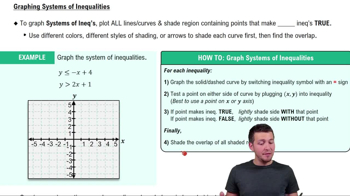
Graph the system of inequalities on a coordinate plane: x \geq 0, y \geq 0, 6x + 5y \geq 30, and 4x + 5y \leq 40.
Identify the feasible region where all inequalities overlap, which is the area of interest.
Determine the corner points of the feasible region by solving the system of equations formed by the intersection of the boundary lines.
Evaluate the objective function z = x + 8y at each corner point to find the corresponding values of z.
Compare the values of z obtained at each corner point to determine the maximum value and the corresponding values of x and y.
Verified video answer for a similar problem:
This video solution was recommended by our tutors as helpful for the problem above
Video duration:
10m
Play a video:
Was this helpful?
Key Concepts
Here are the essential concepts you must grasp in order to answer the question correctly.
Linear Inequalities
Linear inequalities are mathematical expressions that involve a linear function and an inequality sign (such as <, >, ≤, or ≥). They define a region on a graph where the solutions to the inequality exist. In this context, the inequalities represent constraints that limit the feasible solutions for the variables x and y.
Graphing systems of inequalities involves plotting each inequality on a coordinate plane to visualize the feasible region where all constraints are satisfied. The solution set is typically the intersection of the regions defined by each inequality, and it is bounded by the lines representing the equalities of the inequalities.
An objective function is a mathematical expression that defines a quantity to be maximized or minimized, given certain constraints. In this case, the objective function z = x + 8y needs to be evaluated at the vertices (corners) of the feasible region to determine the maximum value, which is essential in optimization problems.