In Exercises 61–64, find the domain of each function. f(x) = 1/√(4x2 - 9x + 2)
Verified step by step guidance
1
Identify the function and the expression inside the square root: . Since the function is , the denominator cannot be zero and the expression inside the square root must be positive.
Set the inequality for the radicand (expression inside the square root) to be greater than zero: .
Solve the quadratic inequality by first finding the roots of the quadratic equation . Use the quadratic formula: where , , and .
Determine the intervals on the number line based on the roots found. Since the parabola opens upward (because ), the quadratic expression is positive outside the roots and negative between them.
Write the domain as the union of intervals where the expression inside the square root is positive, excluding points where the denominator would be zero.
Verified video answer for a similar problem:
This video solution was recommended by our tutors as helpful for the problem above
Video duration:
3m
Play a video:
Was this helpful?
Key Concepts
Here are the essential concepts you must grasp in order to answer the question correctly.
Domain of a Function
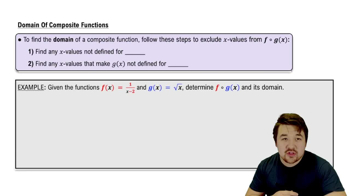
The domain of a function is the set of all input values (x-values) for which the function is defined. For rational and root functions, the domain excludes values that cause division by zero or taking the square root of a negative number.
For a function involving a square root, the expression inside the root (the radicand) must be greater than or equal to zero to produce real number outputs. If the root is in the denominator, the radicand must be strictly greater than zero to avoid division by zero.
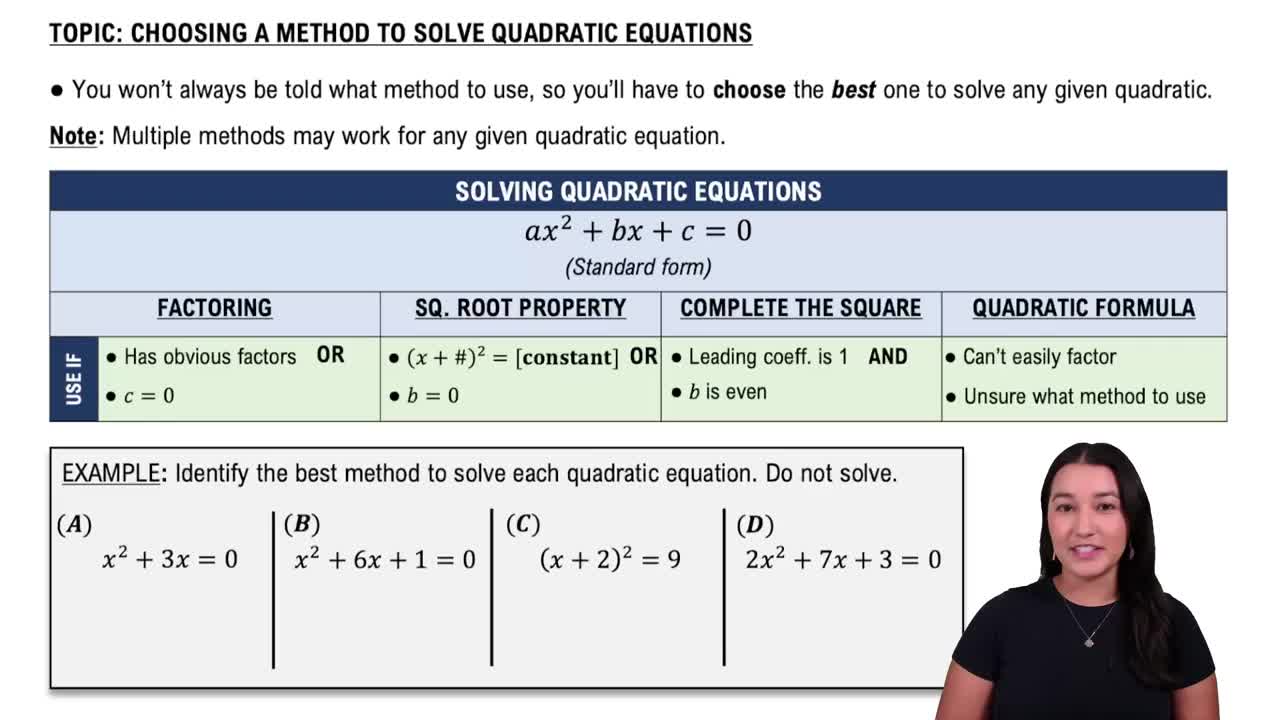
To find where a quadratic expression is positive or non-negative, solve the quadratic inequality by finding its roots and testing intervals. This helps determine the values of x that satisfy the domain restrictions for the function.