Recognize that the expression is a product of two terms with fractional exponents: \((0.2)^{2/3} \times (40)^{2/3}\).
Use the property of exponents that states \(a^m \times b^m = (a \times b)^m\) to combine the terms: \((0.2 \times 40)^{2/3}\).
Calculate the product inside the parentheses: \$0.2 \times 40$.
Rewrite the expression as a single term with a fractional exponent: \((8)^{2/3}\).
Interpret the fractional exponent \$2/3$ as the square of the cube root, so calculate the cube root of 8, then square the result.
Verified video answer for a similar problem:
This video solution was recommended by our tutors as helpful for the problem above
Video duration:
3m
Play a video:
Was this helpful?
Key Concepts
Here are the essential concepts you must grasp in order to answer the question correctly.
Fractional Exponents
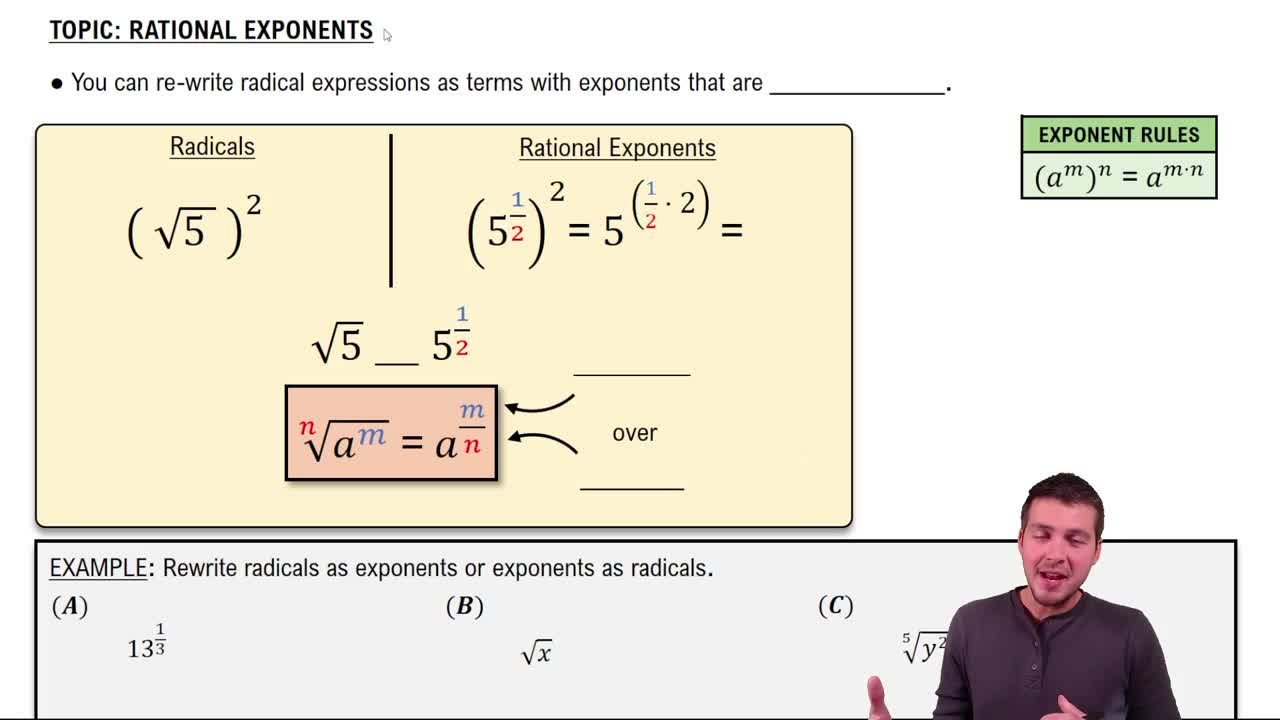
Fractional exponents represent roots and powers simultaneously. For example, an exponent of 2/3 means you square the base and then take the cube root, or vice versa. Understanding how to manipulate fractional exponents is essential for simplifying expressions like (0.2^(2/3)).
The properties of exponents, such as the product rule (a^m * a^n = a^(m+n)) and power of a power rule ((a^m)^n = a^(m*n)), help simplify expressions involving exponents. Recognizing these rules allows you to combine or break down terms efficiently.
Mental math strategies involve simplifying numbers and expressions to perform calculations quickly without paper. For this problem, estimating roots and powers of decimals and whole numbers helps compute the value mentally by breaking down complex expressions into manageable parts.