In Exercises 111–114, simplify each expression. Assume that all variables represent positive numbers. (49x−2y4)−1/2(xy1/2)
Verified step by step guidance
1
Step 1: Begin by simplifying the first term, \((49x^{-2}y^4)^{-1/2}\). Recall that raising a power to a negative exponent means taking the reciprocal of the base and then applying the positive exponent. Rewrite it as \((49x^{-2}y^4)^{-1/2} = \frac{1}{(49x^{-2}y^4)^{1/2}}\).
Step 2: Simplify \((49x^{-2}y^4)^{1/2}\) by applying the square root to each factor inside the parentheses. Use the property \((a^m b^n)^{1/2} = a^{m/2} b^{n/2}\). This gives \((49x^{-2}y^4)^{1/2} = 7x^{-1}y^2\), since \(\sqrt{49} = 7\), \(x^{-2/2} = x^{-1}\), and \(y^{4/2} = y^2\).
Step 3: Substitute the simplified form back into the expression. The first term becomes \(\frac{1}{7x^{-1}y^2}\). Combine this with the second term \(xy^{1/2}\), so the expression is now \(\frac{1}{7x^{-1}y^2} \cdot xy^{1/2}\).
Step 4: Simplify the multiplication. Combine the \(x\)-terms using the property \(x^m \cdot x^n = x^{m+n}\). Here, \(x^{-1} \cdot x = x^{(-1+1)} = x^0 = 1\). For the \(y\)-terms, use \(y^2 \cdot y^{1/2} = y^{(2+1/2)} = y^{5/2}\). The expression now simplifies to \(\frac{1}{7} \cdot y^{5/2}\).
Step 5: Write the final simplified expression as \(\frac{y^{5/2}}{7}\). This is the fully simplified form of the given expression.
Verified video answer for a similar problem:
This video solution was recommended by our tutors as helpful for the problem above
Video duration:
5m
Play a video:
Was this helpful?
Key Concepts
Here are the essential concepts you must grasp in order to answer the question correctly.
Exponents and Negative Exponents
Exponents indicate how many times a number is multiplied by itself. A negative exponent signifies the reciprocal of the base raised to the absolute value of the exponent. For example, x^−n = 1/x^n. Understanding how to manipulate negative exponents is crucial for simplifying expressions involving them.
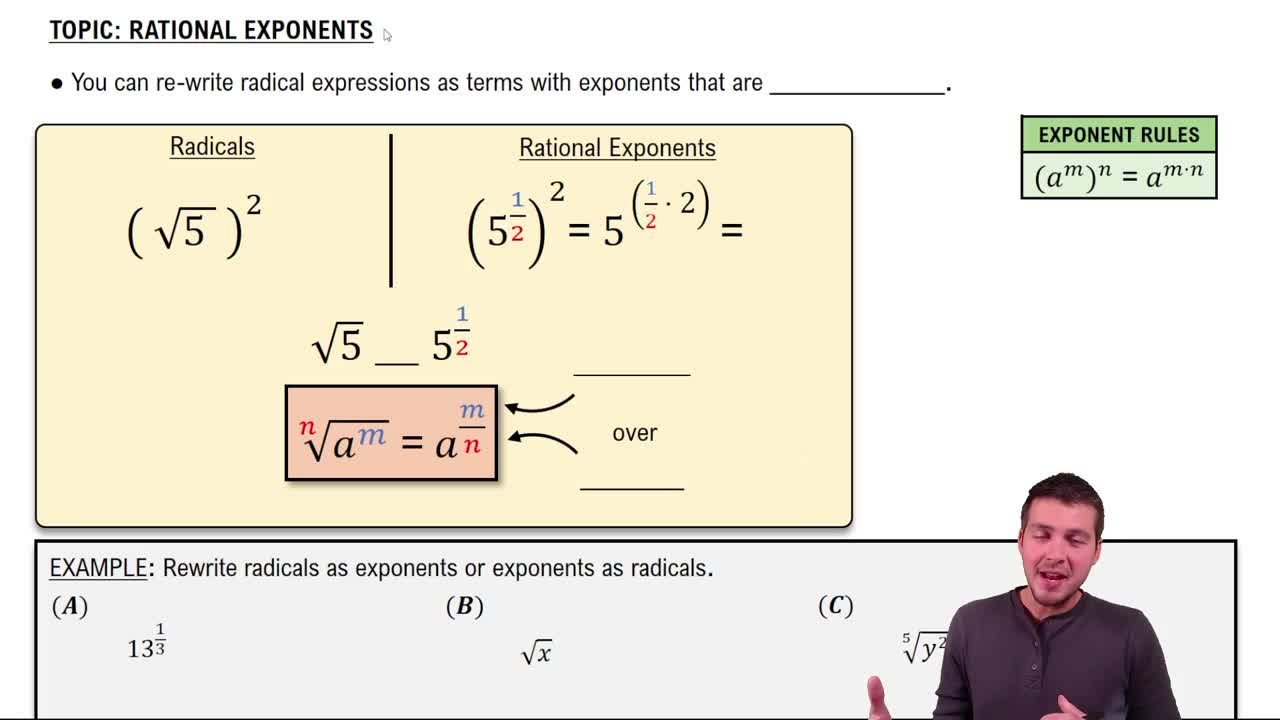
Radicals are expressions that involve roots, such as square roots. Rational exponents provide a way to express roots in exponent form, where a fractional exponent like 1/2 represents the square root. For instance, x^(1/2) = √x. Recognizing the relationship between radicals and rational exponents is essential for simplifying expressions.
Combining like terms involves simplifying expressions by adding or subtracting terms that have the same variable raised to the same power. This process is fundamental in algebra as it helps to reduce expressions to their simplest form. Mastery of this concept allows for clearer and more efficient manipulation of algebraic expressions.