If the expression is in exponential form, write it in radical form and evaluate if possible. If it is in radical form, write it in exponential form. Assume all variables represent posi-tive real numbers. -5z^2/3
Verified step by step guidance
1
Identify the given expression: \(-5z^{2/3}\).
Recognize that the expression is in exponential form, where the exponent is \(\frac{2}{3}\).
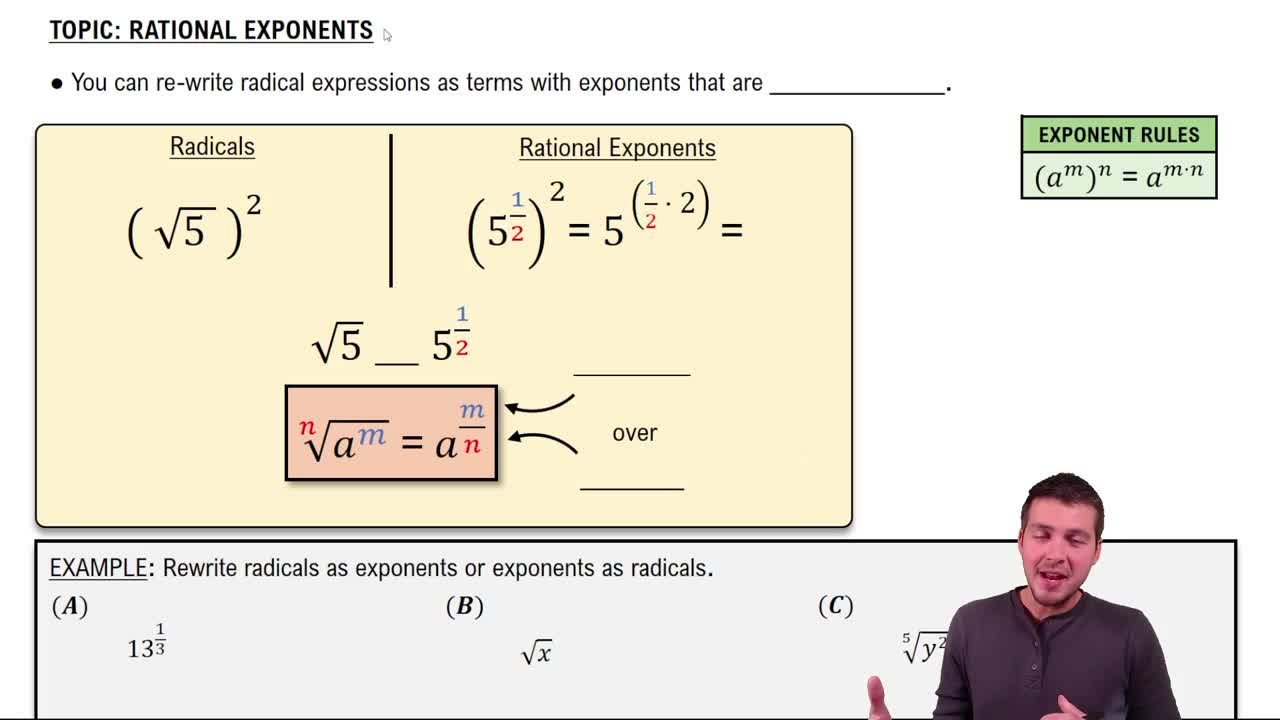
Convert the expression from exponential form to radical form. The exponent \(\frac{2}{3}\) can be rewritten as a radical: \(z^{2/3} = \sqrt[3]{z^2}\).
Rewrite the entire expression in radical form: \(-5 \cdot \sqrt[3]{z^2}\).
The expression is now in radical form, and you can evaluate it further if specific values for \(z\) are provided.
Verified video answer for a similar problem:
This video solution was recommended by our tutors as helpful for the problem above
Video duration:
1m
Play a video:
Was this helpful?
Key Concepts
Here are the essential concepts you must grasp in order to answer the question correctly.
Exponential Form
Exponential form represents numbers using a base raised to a power, such as a^b, where 'a' is the base and 'b' is the exponent. This notation is useful for expressing large numbers compactly and for performing operations like multiplication and division more easily. In the context of the question, the expression -5z^(2/3) is in exponential form, indicating that z is raised to the power of 2/3.
Radical form expresses numbers using roots, such as √a or a^(1/n), where 'n' is the degree of the root. This form is particularly useful for simplifying expressions and solving equations involving roots. In the given expression, converting from exponential to radical form involves rewriting z^(2/3) as the cube root of z squared, which is a key step in the evaluation process.
Positive real numbers are all the numbers greater than zero, including both rational and irrational numbers. In the context of the question, assuming all variables represent positive real numbers ensures that operations involving roots and exponents yield valid results, as negative bases or zero can lead to undefined or complex outcomes in certain cases. This assumption is crucial for correctly evaluating the expressions.