If the expression is in exponential form, write it in radical form and evaluate if possible. If it is in radical form, write it in exponential form. Assume all variables represent positive real numbers. -5z2/3
Verified step by step guidance
1
Identify the given expression: \(-5z^{2/3}\). Notice that the exponent \$2/3$ is a fractional exponent, which means the expression is currently in exponential form.
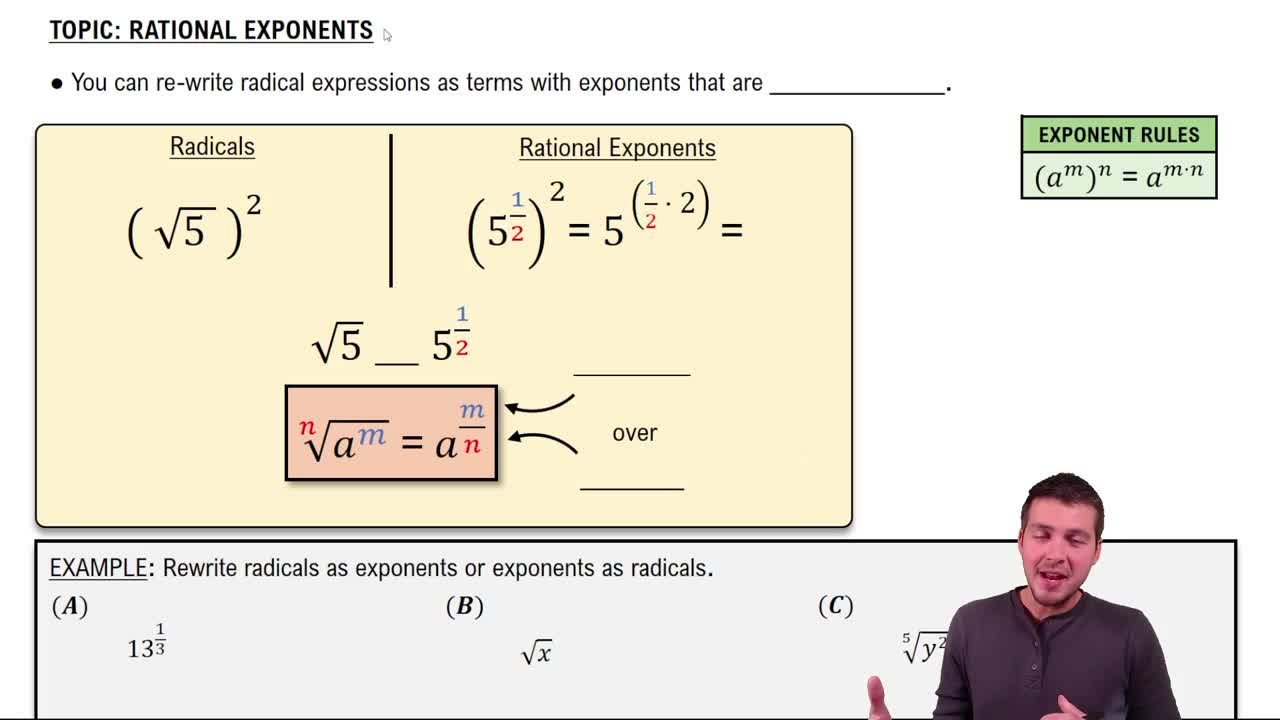
Recall the rule for converting from exponential form to radical form: \(a^{m/n} = \sqrt[n]{a^m} = (\sqrt[n]{a})^m\). Here, the denominator of the exponent (3) is the root, and the numerator (2) is the power.
Rewrite \(z^{2/3}\) in radical form as \(\left(\sqrt[3]{z}\right)^2\) or equivalently \(\sqrt[3]{z^2}\). So the entire expression becomes \(-5 \left(\sqrt[3]{z}\right)^2\) or \(-5 \sqrt[3]{z^2}\).
Since the problem states to evaluate if possible, and variables represent positive real numbers, you can leave the expression in radical form as is because it cannot be simplified further without knowing the value of \(z\).
If you were to convert back to exponential form from the radical form \(-5 \sqrt[3]{z^2}\), you would write it as \(-5 z^{2/3}\), confirming the equivalence of the two forms.
Verified video answer for a similar problem:
This video solution was recommended by our tutors as helpful for the problem above
Video duration:
1m
Play a video:
Was this helpful?
Key Concepts
Here are the essential concepts you must grasp in order to answer the question correctly.
Exponential and Radical Forms
Exponential form expresses roots using fractional exponents, where a root like the cube root of x is written as x^(1/3). Radical form uses the root symbol, such as √ or ∛, to denote roots. Converting between these forms involves rewriting fractional exponents as radicals and vice versa.
A fractional exponent like x^(m/n) means the nth root of x raised to the mth power, or equivalently (√[n]{x})^m. Understanding this allows you to convert expressions between radical and exponential forms and to simplify or evaluate them when possible.
Evaluating Expressions with Positive Real Variables
When variables represent positive real numbers, roots and fractional powers are well-defined and real. This assumption ensures that expressions like z^(2/3) can be evaluated without considering complex numbers, simplifying the process of rewriting and evaluating the expression.