Solve each equation. See Examples 4–6. ∛(4x+3)=∛(2x-1)
Verified step by step guidance
1
Recognize that the equation involves cube roots on both sides: \(\sqrt[3]{4x+3} = \sqrt[3]{2x-1}\).
Since cube root is a one-to-one function, set the expressions inside the cube roots equal to each other: \$4x + 3 = 2x - 1$.
Solve the resulting linear equation by isolating \(x\): subtract \$2x\( from both sides to get \)4x - 2x + 3 = -1\( which simplifies to \)2x + 3 = -1$.
Continue solving for \(x\) by subtracting 3 from both sides: \$2x = -1 - 3\( which simplifies to \)2x = -4$.
Divide both sides by 2 to isolate \(x\): \(x = \frac{-4}{2}\).
Verified video answer for a similar problem:
This video solution was recommended by our tutors as helpful for the problem above
Video duration:
1m
Play a video:
Was this helpful?
Key Concepts
Here are the essential concepts you must grasp in order to answer the question correctly.
Cube Roots and Radicals
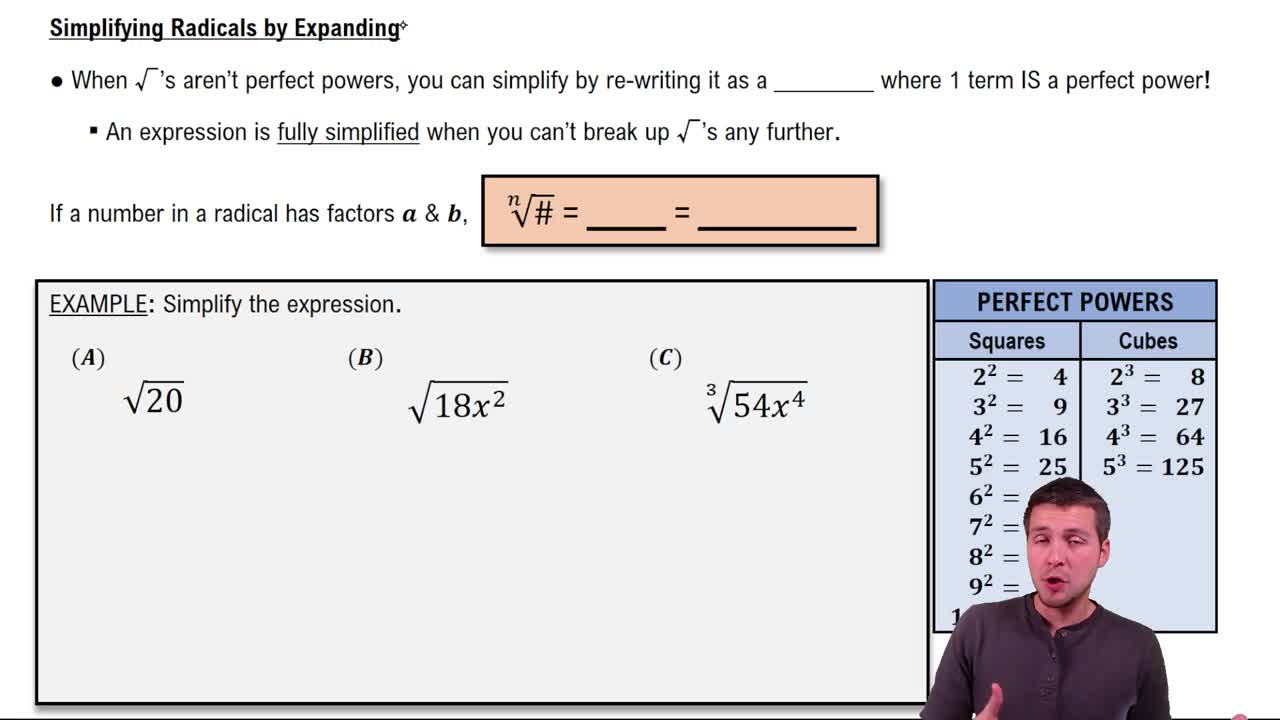
A cube root of a number is a value that, when multiplied by itself three times, gives the original number. Understanding how to work with cube roots and their properties is essential for solving equations involving radicals, such as ∛(4x+3) = ∛(2x-1).
When two cube roots are equal, their radicands (the expressions inside the roots) must be equal. This allows us to set the expressions inside the cube roots equal to each other, simplifying the equation to 4x + 3 = 2x - 1, which can then be solved using algebraic methods.
After equating the radicands, the resulting equation is linear. Solving linear equations involves isolating the variable on one side using inverse operations like addition, subtraction, multiplication, or division. This step yields the solution for x.