Pearson+ LogoPearson+ Logo
Ch.4 Atoms and Elements
Timberlake - Chemistry: An Introduction to General, Organic, and Biological Chemistry 13th Edition
Timberlake13th EditionChemistry: An Introduction to General, Organic, and Biological ChemistryISBN: 9780134421353Not the one you use?Change textbook
Chapter 4, Problem 93c

Indicate if each of the following statements is true or false:
c. The atomic mass unit is based on a carbon atom with six protons and six neutrons.

Verified step by step guidance
1
Understand the concept of atomic mass unit (amu): The atomic mass unit is a standard unit of mass used to express atomic and molecular weights. It is defined based on the carbon-12 isotope.
Recall the definition of the carbon-12 isotope: The carbon-12 isotope has six protons and six neutrons in its nucleus, giving it a total of 12 nucleons.
Know the basis of the atomic mass unit: By definition, 1 atomic mass unit (amu) is exactly 1/12th the mass of a carbon-12 atom.
Evaluate the statement: The statement claims that the atomic mass unit is based on a carbon atom with six protons and six neutrons, which aligns with the definition of the carbon-12 isotope.
Conclude whether the statement is true or false: Since the atomic mass unit is indeed based on the carbon-12 isotope, the statement is true.

Verified video answer for a similar problem:

This video solution was recommended by our tutors as helpful for the problem above.
Video duration:
41s
Was this helpful?

Key Concepts

Here are the essential concepts you must grasp in order to answer the question correctly.

Atomic Mass Unit (amu)

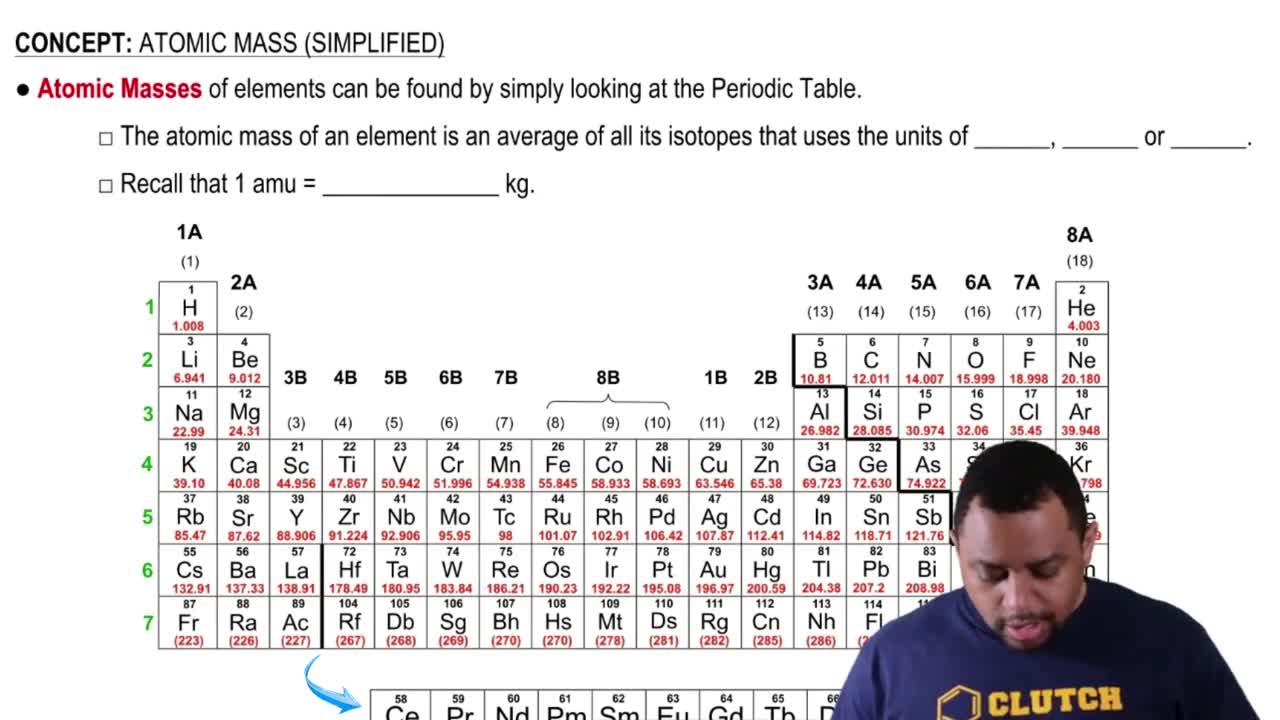
The atomic mass unit (amu) is a standard unit of mass that quantifies mass on an atomic or molecular scale. It is defined as one twelfth of the mass of a carbon-12 atom, which has six protons and six neutrons. This unit allows for the comparison of the masses of different atoms and molecules in a consistent manner.
Recommended video:
Guided course
01:13
Atomic Mass (Conceptual) Concept 1

Carbon-12 Isotope

Carbon-12 is a stable isotope of carbon, consisting of six protons and six neutrons. It is the most abundant isotope of carbon and serves as the standard reference for defining the atomic mass unit. The choice of carbon-12 as a reference point is crucial for ensuring uniformity in atomic mass measurements across different elements.
Recommended video:

Protons and Neutrons

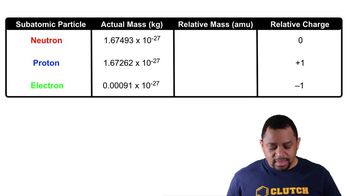
Protons and neutrons are subatomic particles found in the nucleus of an atom. Protons carry a positive charge, while neutrons are neutral. The number of protons determines the atomic number and identity of an element, while the total number of protons and neutrons gives the atomic mass. Understanding their roles is essential for grasping atomic structure and mass calculations.
Recommended video:
Guided course
02:36
Subatomic Particles (Simplified) Concept 2