Ch. 5 - Genetics
Norman-McKay- Microbiology: Basic and Clinical Principles 2nd Edition
Norman-McKay2nd EditionMicrobiology: Basic and Clinical PrinciplesISBN: 9780137661619Not the one you use?Change textbook
Chapter 5, Problem 5

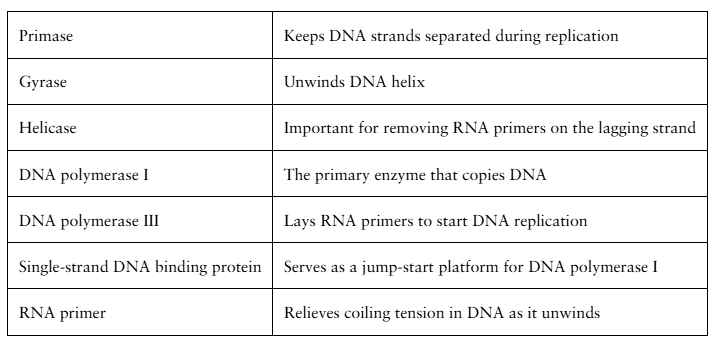
Match the following:
Table matching DNA replication enzymes and proteins with their specific functions during the replication process.

Verified step by step guidance
1
Since the problem asks to match items from a list (likely terms and definitions or images and labels), start by carefully examining each item in both columns or groups to understand their characteristics or definitions.
Identify key features or keywords in each item that can help you find a logical connection or relationship between the pairs. For example, if the items are microbiological terms and their descriptions, look for unique traits or functions.
Use the process of elimination by matching the most obvious pairs first. This will reduce the number of remaining options and make it easier to match the more challenging pairs.
Double-check each match by verifying that the paired items are consistent with microbiological concepts, such as matching a bacterial structure with its function or a microorganism with its disease.
Review all matches once more to ensure accuracy and completeness before finalizing your answers.

Verified video answer for a similar problem:

This video solution was recommended by our tutors as helpful for the problem above.
Video duration:
2m
Was this helpful?

Key Concepts

Here are the essential concepts you must grasp in order to answer the question correctly.

Microbial Classification and Identification

Understanding how microorganisms are classified based on their morphology, physiology, and genetic characteristics is essential for matching different microbes to their descriptions or images. This includes knowledge of bacterial shapes, staining properties, and metabolic traits.
Recommended video:
Guided course
04:56
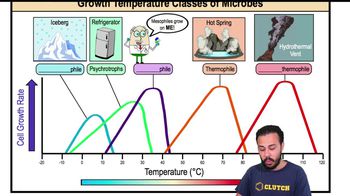
Classification of Microbes by Growth Temperature

Microscopy and Staining Techniques

Microscopy methods, such as light and electron microscopy, along with staining techniques like Gram staining, help visualize and differentiate microbes. Recognizing these techniques aids in interpreting images and matching them to the correct microbial types.
Recommended video:
Guided course
03:46
Light Microscopy: Bright-Field Microscopes

Microbial Physiology and Metabolism

Knowledge of microbial metabolic processes and physiological traits, such as oxygen requirements or nutrient utilization, is crucial for linking microbes to their functional characteristics. This helps in accurately matching microbes to their descriptions or images.
Recommended video:
Guided course
02:17
Introduction to Metabolism
Related Practice
Textbook Question

Codons are ___________ nucleotides long and are in ___________, which is transcribed from DNA. During ___________, tRNAs serve as adapter molecules to bring ___________ to the ribosome to build a protein. Once the ribosome reaches a(n) ___________ on the mRNA, translation ends.

1258
views
Textbook Question

List three features of the genetic code.

1626
views
Textbook Question

Select the false statement:

a. DNA is made of deoxyribonucleotides.

b. RNA is made of ribonucleotides.

c. RNA is built in a 5' to 3' direction.

d. DNA is built in a 5' to 3' direction.

e. RNA primase builds RNA in transcription.

1237
views
Textbook Question

Indicate the true statements and then correct the false statements so that they are true.

a. DNA is replicated in a 3' to 5' direction.

b. DNA has a parallel arrangement.

c. RNA primase is required on the leading and the lagging strand.

d. DNA ligase forms phosphodiester bonds between Okazaki fragments on the lagging strand.

e. Prokaryotic mRNA requires processing before it is translated.

f. In RNA, A bonds to U.

g. In DNA, C bonds with G.

h. RNA contains deoxyribonucleotides.

815
views
Textbook Question

Assume you have the DNA sequence 3'-ACGTATCCAGCAGCTCCACCAA-5'.

Use the genetic code table found in the chapter to answer the following questions:

a. What would the complementary DNA sequence be?

b. What would the corresponding mRNA sequence be?

c. Could the mRNA sequence you generated be translated? Why or why not?

1321
views
Textbook Question

During ___________ a pilus forms between an F+ and an Fcell and allows for the exchange of genetic material. By the end of the process, the previously F cell is converted to a(n) ___________ cell.

1511
views