
Ch. 7 - Microbial Genetics
Bauman - Microbiology with Diseases by Taxonomy 6th Edition
Bauman6th EditionMicrobiology with Diseases by TaxonomyISBN: 9780134832302Not the one you use?Change textbook
Chapter 7, Problem 12

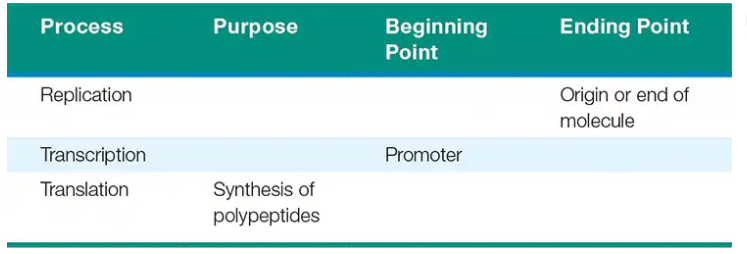
Fill in the following table:


Table listing biological processes with their purposes and start/end points: replication, transcription, and translation.

Verified step by step guidance
1
Step 1: Understand the biological processes listed: Replication, Transcription, and Translation. Each has a specific purpose, a starting point on the DNA or RNA, and an ending point where the process concludes.
Step 2: For Replication, the purpose is to copy the entire DNA molecule. The beginning point is the origin of replication, where the process starts, and the ending point is the end of the molecule or when the entire DNA has been copied.
Step 3: For Transcription, the purpose is to synthesize RNA from a DNA template. The beginning point is the promoter region on the DNA, which signals RNA polymerase where to start. The ending point is the terminator sequence, where transcription stops.
Step 4: For Translation, the purpose is the synthesis of polypeptides (proteins) from mRNA. The beginning point is the start codon (usually AUG) on the mRNA, and the ending point is the stop codon (such as UAA, UAG, or UGA) where the ribosome releases the completed polypeptide.
Step 5: Fill in the table accordingly: Replication's beginning point is 'Origin of replication', ending point is 'End of molecule'; Transcription's ending point is 'Terminator'; Translation's beginning point is 'Start codon', and ending point is 'Stop codon'.

Verified video answer for a similar problem:

This video solution was recommended by our tutors as helpful for the problem above.
Video duration:
1m
Was this helpful?

Key Concepts

Here are the essential concepts you must grasp in order to answer the question correctly.

DNA Replication

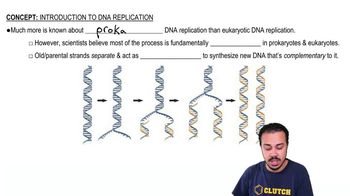
DNA replication is the process by which a cell copies its entire DNA molecule before cell division. It begins at specific sites called origins of replication and proceeds bidirectionally until the entire molecule is duplicated. This ensures genetic information is accurately passed to daughter cells.
Recommended video:
Guided course
03:37
Introduction to DNA Replication

Transcription

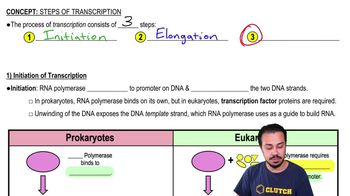
Transcription is the synthesis of RNA from a DNA template. It starts at the promoter region of a gene, where RNA polymerase binds, and ends at a terminator sequence. This process produces messenger RNA (mRNA) that carries genetic information for protein synthesis.
Recommended video:
Guided course
04:16
Initiation of Transcription

Translation

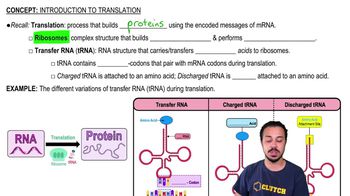
Translation is the process of synthesizing polypeptides (proteins) from the mRNA template. It begins at the start codon on the mRNA and ends at a stop codon. Ribosomes facilitate the decoding of mRNA into a specific sequence of amino acids forming a functional protein.
Recommended video:
Guided course
06:12
Introduction to Translation