Ch. 13 - Characterizing and Classifying Viruses, Viroids, and Prions
Bauman - Microbiology with Diseases by Taxonomy 6th Edition
Bauman6th EditionMicrobiology with Diseases by TaxonomyISBN: 9780134832302Not the one you use?Change textbook
Chapter 13, Problem 8

Describe lysogeny.

Verified step by step guidance
1
Understand that lysogeny is a type of viral life cycle specific to bacteriophages, which are viruses that infect bacteria.
Recognize that in lysogeny, the bacteriophage's DNA integrates into the host bacterium's genome, becoming a prophage.
Note that the prophage DNA replicates along with the host cell's DNA without causing immediate harm or lysis to the host.
Explain that the lysogenic cycle allows the virus to remain dormant within the host until certain conditions trigger it to enter the lytic cycle, where new viruses are produced and the host cell is lysed.
Summarize that lysogeny is a form of viral dormancy and genetic integration that enables the virus to persist in the bacterial population over time.

Verified video answer for a similar problem:

This video solution was recommended by our tutors as helpful for the problem above.
Video duration:
2m
Was this helpful?

Key Concepts

Here are the essential concepts you must grasp in order to answer the question correctly.

Lysogeny

Lysogeny is a viral life cycle in which a bacteriophage integrates its genome into the host bacterium's DNA, becoming a prophage. Instead of immediately destroying the host, the virus remains dormant and replicates along with the host cell.
Recommended video:
Guided course
03:37
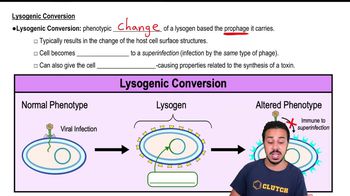
Lysogenic Conversion

Prophage

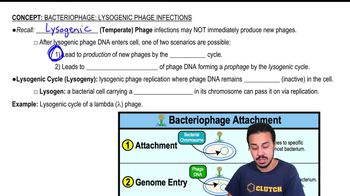
A prophage is the viral DNA integrated into the bacterial chromosome during lysogeny. It can remain inactive for many generations but may later be induced to enter the lytic cycle, producing new viruses and lysing the host.
Recommended video:
Guided course
05:27
Bacteriophage: Lysogenic Phage Infections

Lytic vs Lysogenic Cycle

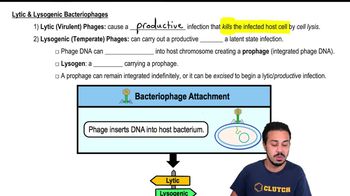
The lytic cycle involves active viral replication and host cell destruction, while the lysogenic cycle involves viral dormancy within the host genome. Understanding the switch between these cycles is key to grasping lysogeny.
Recommended video:
Guided course
04:34
Lytic & Lysogenic Bacteriophages