Ch. 15 - Innate Immunity
Bauman - Microbiology with Diseases by Taxonomy 6th Edition
Bauman6th EditionMicrobiology with Diseases by TaxonomyISBN: 9780134832302Not the one you use?Change textbook
Chapter 15, Problem 15

Indicate which statements are true. Correct all false statements by changing the underlined words.
__________ NETs are webs produced by neutrophils to trap microbes.

Verified step by step guidance
1
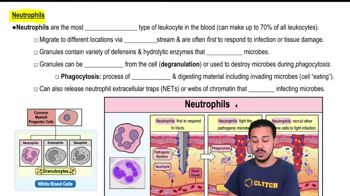
Understand that NETs stands for Neutrophil Extracellular Traps, which are indeed web-like structures produced by neutrophils to trap and kill microbes.
Identify that the statement 'NETs are webs produced by neutrophils to trap microbes' is true as it correctly describes the function and origin of NETs.
Since the statement is true, no correction is needed for the underlined words in this sentence.
Recall that NETs are composed mainly of DNA fibers combined with antimicrobial proteins, which help immobilize and kill pathogens.
Conclude that the statement accurately reflects the biological role of NETs in the immune response.

Verified video answer for a similar problem:

This video solution was recommended by our tutors as helpful for the problem above.
Video duration:
2m
Was this helpful?

Key Concepts

Here are the essential concepts you must grasp in order to answer the question correctly.

Neutrophil Extracellular Traps (NETs)

NETs are networks of extracellular fibers, primarily composed of DNA from neutrophils, that trap and kill microbes. They are released during a process called NETosis, helping the immune system contain infections by immobilizing pathogens.
Recommended video:

Neutrophil Function in Innate Immunity

Neutrophils are white blood cells that serve as first responders in innate immunity. They kill pathogens through phagocytosis, degranulation, and NET formation, playing a crucial role in controlling infections rapidly.
Recommended video:
Guided course
02:30
Introduction to Innate Immunity

Mechanism of NET Formation (NETosis)

NETosis is a unique form of cell death where neutrophils release chromatin and antimicrobial proteins to form NETs. This process traps microbes extracellularly, preventing their spread and facilitating their destruction by immune factors.
Recommended video:
Guided course
01:59
Introduction to Avoiding Host Defense Mechanisms