
A cell may allow a large or charged chemical to move across the cytoplasmic membrane, down the chemical’s electrical and chemical gradients, in a process called _________ . .
a. active transport b. facilitated diffusion c. endocytosis d. pinocytosis
Verified step by step guidance
1
Identify the key characteristics of the process described: movement of a large or charged chemical across the cytoplasmic membrane, down its electrical and chemical gradients.
Understand that moving down a gradient typically implies a passive process, as opposed to moving against a gradient which requires energy.
Review the definitions of the given options: active transport, facilitated diffusion, endocytosis, and pinocytosis.
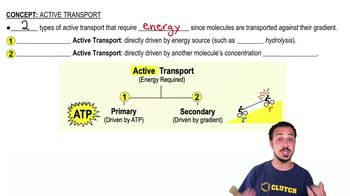
Recognize that active transport requires energy to move substances against their gradients, which does not match the description.
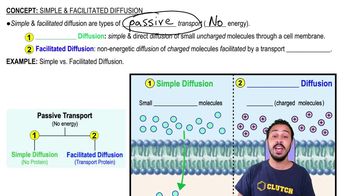
Determine that facilitated diffusion involves the passive transport of substances down their gradients with the help of a protein, matching the process described.
Verified video answer for a similar problem:
This video solution was recommended by our tutors as helpful for the problem above
Video duration:
4m
Play a video:
Was this helpful?
Key Concepts
Here are the essential concepts you must grasp in order to answer the question correctly.
Facilitated Diffusion
Facilitated diffusion is a passive transport process that allows substances to cross membranes with the assistance of special proteins. This mechanism is crucial for the movement of large or charged molecules that cannot easily pass through the lipid bilayer. The process occurs down the concentration gradient, meaning substances move from areas of higher concentration to lower concentration without the use of energy.
Chemical and electrical gradients refer to the differences in concentration and charge across a membrane. The chemical gradient is the difference in the concentration of a substance, while the electrical gradient is the difference in charge. Together, these gradients drive the movement of ions and molecules across the membrane, influencing processes like facilitated diffusion and active transport.
Transport mechanisms in cells can be classified as passive or active. Passive transport, such as facilitated diffusion, does not require energy and relies on the natural movement of molecules down their gradients. In contrast, active transport requires energy, usually in the form of ATP, to move substances against their gradients, allowing cells to maintain concentration differences essential for various cellular functions.