Back
Back
Problem 1
The koala is a leaf-eating animal. What can you infer about its digestive system?
Problem 2
Give one possible explanation of why Penicillium would make penicillin, given that the fungus does not get bacterial infections.
Problem 3
In the sulfur cycle, microbes degrade organic sulfur compounds, such as (a) _________________, to release H₂S, which can be oxidized by Acidithiobacillus to (b) _________________. This ion can be assimilated into amino acids by (c) _________________ or reduced by Desulfovibrio to (d) _________________. H2S is used by photoautotrophic bacteria as an electron donor to synthesize (e) _________________. The sulfur-containing by-product of this metabolism is (f) _________________.
Problem 4
Why is the phosphorus cycle important?
Problem 5
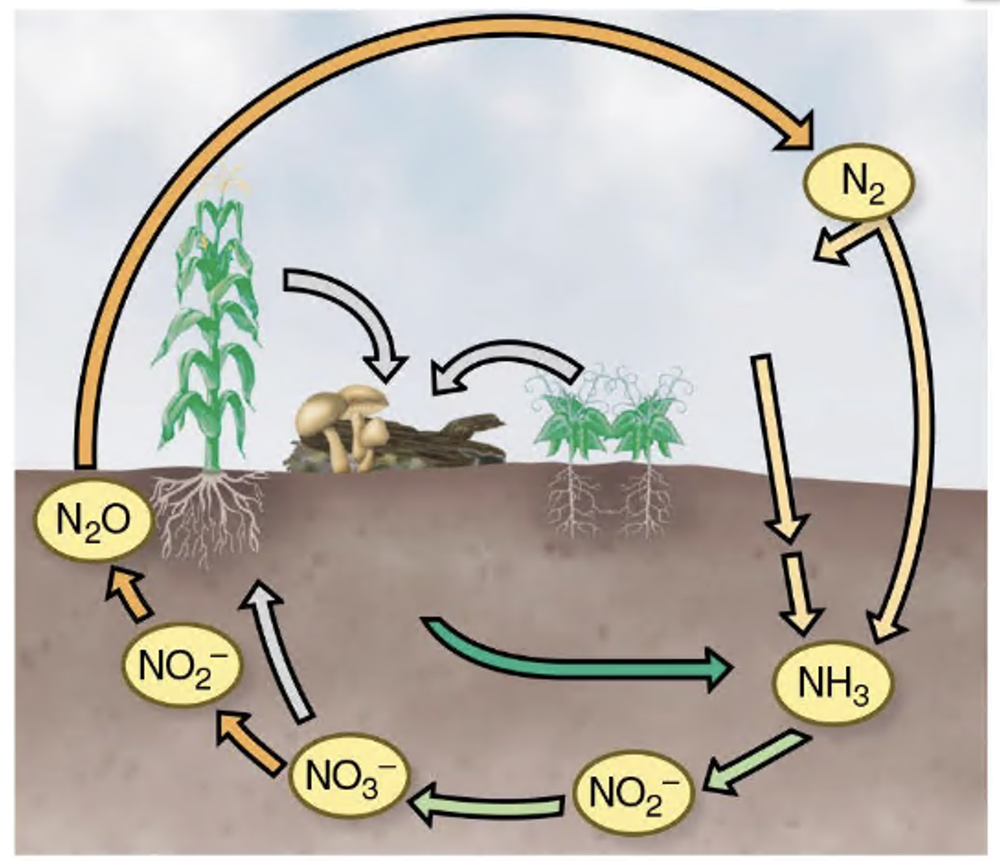
Identify where the following processes occur: ammonification, decomposition, denitrification, nitrification, nitrogen fixation. Name at least one organism responsible for each process.
Problem 6
The following organisms have important roles as symbionts with plants and fungi; describe the symbiotic relationship of each organism with its host: cyanobacteria, mycorrhizae, Rhizobium, Frankia.
Problem 7
Outline the treatment process for drinking water.
Problem 8
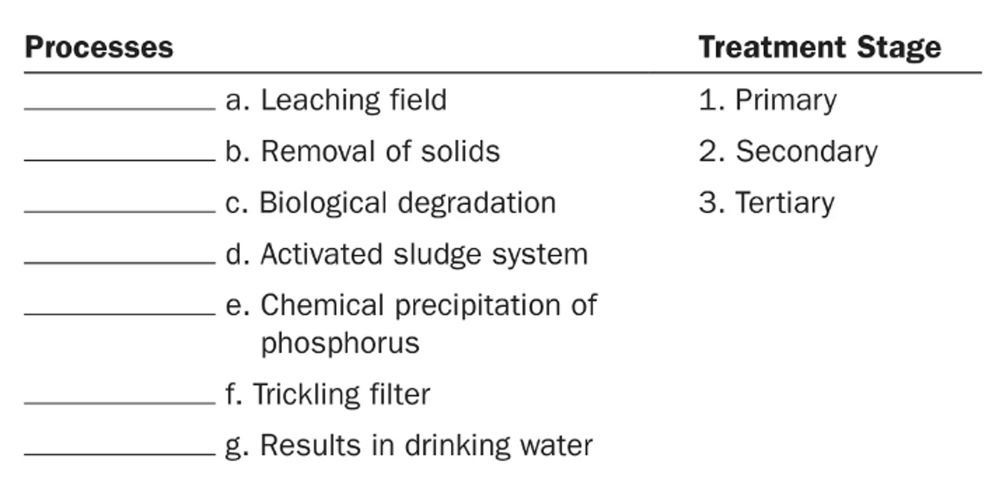
The following processes are used in wastewater treatment. Match the stage of treatment with the processes. Each choice can be used once, more than once, or not at all.
Problem 9
Bioremediation refers to the use of living organisms to remove pollutants. Describe three examples of bioremediation.
Problem 10
These nitrogen-fixing prokaryotes provide nitrogen fertilizer in rice paddies; they live symbiotically in the cells of the freshwater plant Azolla.
Problem 1
For the following question, answer whether
a. The process takes place under aerobic conditions.
b. The process takes place under anaerobic conditions.
c. The amount of oxygen doesn’t make any difference.
Activated sludge system
Problem 2
For the following question, answer whether
a. The process takes place under aerobic conditions.
b. The process takes place under anaerobic conditions.
c. The amount of oxygen doesn’t make any difference.
Denitrification
Problem 3
For the following question, answer whether
a. The process takes place under aerobic conditions.
b. The process takes place under anaerobic conditions.
c. The amount of oxygen doesn’t make any difference.
Nitrogen fixation
Problem 4
For the following question, answer whether
a. The process takes place under aerobic conditions.
b. The process takes place under anaerobic conditions.
c. The amount of oxygen doesn’t make any difference.
Methane production
Problem 5
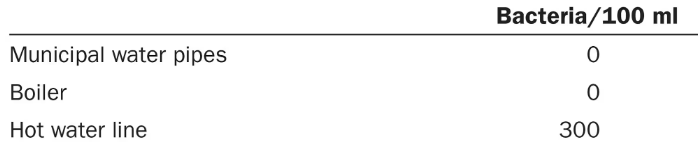
The water used to prepare intravenous solutions in a hospital contained endotoxins. Infection control personnel performed plate counts to find the source of the bacteria. Their results:
All of the following conclusions about the bacteria can be drawn except which one?
a. They were present as a biofilm in the pipes.
b. They are gram-negative.
c. They come from fecal contamination.
d. They come from the city water supply.
e. none of the above
Problem 6
Use the following choices to answer the question:
a. Aerobic respiration
b. Anaerobic respiration
c. Anoxygenic photosynthesis
d. Oxygenic photosynthesis
Problem 7
Use the following choices to answer the question:
a. Aerobic respiration
b. Anaerobic respiration
c. Anoxygenic photosynthesis
d. Oxygenic photosynthesis
Problem 8
Use the following choices to answer the question:
a. Aerobic respiration
b. Anaerobic respiration
c. Anoxygenic photosynthesis
d. Oxygenic photosynthesis
Problem 9
All of the following are effects of water pollution except
a. The spread of infectious diseases.
b. Increased eutrophication.
c. Increased BOD.
d. Increased growth of algae.
e. None of the above; all of these are effects of water pollution.
Problem 10
Coliforms are used as indicator organisms of sewage pollution because
a. They are pathogens.
b. They ferment lactose.
c. They are abundant in human intestines.
d. They grow within 48 hours.
e. All of the above.