
Ch. 19 Blood
Martini - Fundamentals of Anatomy & Physiology 11th Edition
Martini, Nath, Bartholomew11th EditionFundamentals of Anatomy & PhysiologyISBN: 9780136874089Not the one you use?Change textbook
Chapter 19, Problem 19

Dehydration would:
(a) Cause an increase in the hematocrit
(b) Cause a decrease in the hematocrit
(c) Have no effect on the hematocrit
(d) Cause an increase in plasma volume

Verified step by step guidance
1
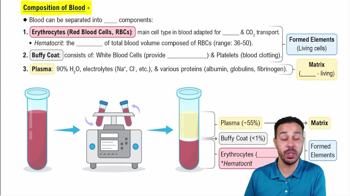
Step 1: Understand what hematocrit is. Hematocrit is the percentage of red blood cells (RBCs) in the total blood volume. It is calculated as: \(\text{Hematocrit} = \frac{\text{Volume of RBCs}}{\text{Total blood volume}} \times 100\%\).
Step 2: Consider what happens during dehydration. Dehydration causes a loss of water from the body, which reduces the plasma (fluid) volume in the blood but does not immediately change the number of red blood cells.
Step 3: Analyze the effect of reduced plasma volume on hematocrit. Since plasma volume decreases but RBC volume remains relatively constant, the ratio of RBC volume to total blood volume increases.
Step 4: Conclude the effect on hematocrit. Because the denominator (total blood volume) decreases due to less plasma, the hematocrit value increases.
Step 5: Eliminate other options based on this reasoning: (b) decrease in hematocrit and (d) increase in plasma volume are inconsistent with dehydration effects, and (c) no effect is unlikely because plasma volume changes.

Verified video answer for a similar problem:

This video solution was recommended by our tutors as helpful for the problem above.
Was this helpful?

Key Concepts

Here are the essential concepts you must grasp in order to answer the question correctly.

Hematocrit Definition

Hematocrit is the percentage of red blood cells (RBCs) in the total blood volume. It reflects the proportion of blood composed of cells versus plasma, and is commonly used to assess blood concentration and oxygen-carrying capacity.
Recommended video:
7:49
Composition of Blood

Effects of Dehydration on Blood Volume

Dehydration reduces the body's total fluid volume, primarily decreasing plasma volume. This leads to a relative increase in the concentration of red blood cells, as the plasma component shrinks while RBC count remains constant.
Recommended video:
1:32
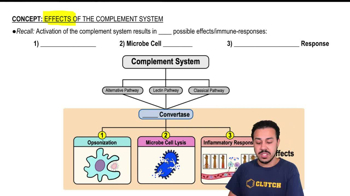
Effects of the Complement System

Relationship Between Plasma Volume and Hematocrit

Since hematocrit is the ratio of RBC volume to total blood volume, a decrease in plasma volume (due to dehydration) raises hematocrit values. Conversely, an increase in plasma volume dilutes RBCs, lowering hematocrit.
Recommended video:
6:40
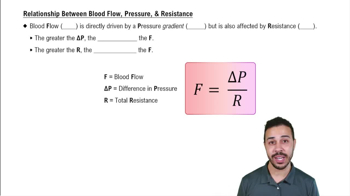
Relationship Between Blood Flow, Pressure, & Resistance