Ch. 12 Nervous Tissue
Martini - Fundamentals of Anatomy & Physiology 11th Edition
Martini, Nath, Bartholomew11th EditionFundamentals of Anatomy & PhysiologyISBN: 9780136874089Not the one you use?Change textbook
Chapter 12, Problem 9b

What are the major components of the peripheral nervous system?

Verified step by step guidance
1
Understand that the peripheral nervous system (PNS) consists of all the nerves and ganglia outside the brain and spinal cord, connecting the central nervous system (CNS) to the rest of the body.
Identify the two main divisions of the PNS: the sensory (afferent) division and the motor (efferent) division.
Recognize that the sensory division carries information from sensory receptors to the CNS, while the motor division transmits commands from the CNS to muscles and glands.
Further divide the motor division into the somatic nervous system, which controls voluntary movements of skeletal muscles, and the autonomic nervous system, which regulates involuntary functions like heart rate and digestion.
Note that the autonomic nervous system itself has two subdivisions: the sympathetic division (responsible for 'fight or flight' responses) and the parasympathetic division (responsible for 'rest and digest' activities).

Verified video answer for a similar problem:

This video solution was recommended by our tutors as helpful for the problem above.
Was this helpful?

Key Concepts

Here are the essential concepts you must grasp in order to answer the question correctly.

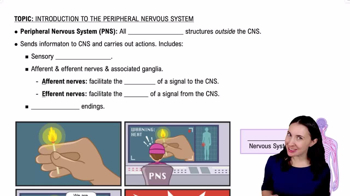
Peripheral Nervous System (PNS)

The peripheral nervous system consists of all the nerves and ganglia outside the brain and spinal cord. It connects the central nervous system to limbs and organs, facilitating communication between the body and brain.
Recommended video:
3:33
Peripheral Nervous System

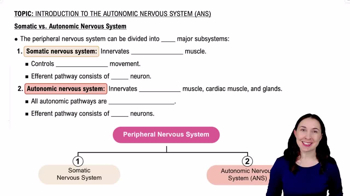
Somatic Nervous System

The somatic nervous system is a part of the PNS responsible for voluntary control of skeletal muscles. It transmits sensory information to the CNS and carries motor commands to muscles, enabling conscious movement.
Recommended video:
1:50
Somatic vs. Autonomic Nervous System

Autonomic Nervous System

The autonomic nervous system controls involuntary bodily functions like heart rate, digestion, and respiration. It is divided into sympathetic and parasympathetic divisions, which have opposing effects to maintain homeostasis.
Recommended video:
1:50
Somatic vs. Autonomic Nervous System