Ch. 4 The Tissue Level of Organization
Martini - Fundamentals of Anatomy & Physiology 11th Edition
Martini, Nath, Bartholomew11th EditionFundamentals of Anatomy & PhysiologyISBN: 9780136874089Not the one you use?Change textbook
Chapter 4, Problem 28

Why does damaged cartilage heal slowly?
(a) Chondrocytes cannot be replaced if killed, and other cell types must take their place.
(b) Cartilage is avascular, so nutrients and other molecules must diffuse to the site of injury.
(c) Damaged cartilage becomes calcified, thus blocking the movement of materials required for healing.
(d) Chondrocytes divide more slowly than other cell types, delaying the healing process.
(e) Damaged collagen cannot be quickly replaced, thereby slowing the healing process.

Verified step by step guidance
1
Understand that cartilage is a type of connective tissue that provides support and cushioning in joints and other areas.
Recall that cartilage is avascular, meaning it lacks blood vessels, which limits the direct supply of nutrients and oxygen to the tissue.
Recognize that because of this avascularity, nutrients and waste products must move by diffusion through the matrix to reach chondrocytes, the cells responsible for maintaining cartilage.
Realize that diffusion is a slower process compared to direct blood supply, which slows down the delivery of essential molecules needed for repair and healing.
Conclude that the slow healing of damaged cartilage is primarily due to its avascular nature, making option (b) the correct explanation.

Verified video answer for a similar problem:

This video solution was recommended by our tutors as helpful for the problem above.
Video duration:
4m
Was this helpful?

Key Concepts

Here are the essential concepts you must grasp in order to answer the question correctly.

Avascular Nature of Cartilage

Cartilage lacks blood vessels, meaning it does not receive direct blood supply. Nutrients and oxygen must diffuse through the dense extracellular matrix to reach chondrocytes, which slows down metabolic processes and delays healing after injury.
Recommended video:
Guided course
03:34
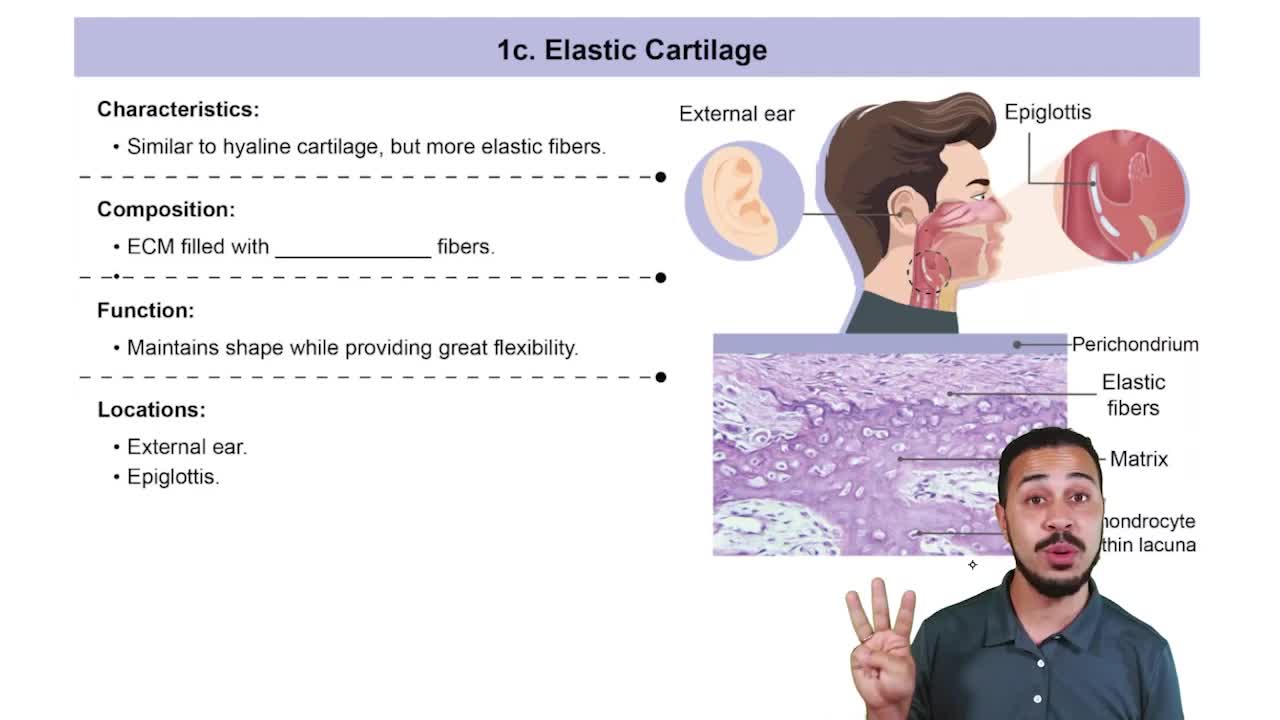
Elastic Cartilage

Role of Chondrocytes in Cartilage Repair

Chondrocytes are the specialized cells responsible for maintaining and repairing cartilage. Their limited ability to proliferate and replace damaged cells contributes to the slow healing process in cartilage tissue.
Recommended video:
03:20
DNA Repair

Extracellular Matrix Composition and Repair

Cartilage's extracellular matrix, rich in collagen and proteoglycans, provides structural support but is slow to regenerate. Damage to collagen fibers impairs the matrix's integrity, and their slow replacement further delays cartilage repair.
Recommended video:
03:20
DNA Repair