Ch. 3 The Cellular Level of Organization
Martini - Fundamentals of Anatomy & Physiology 11th Edition
Martini, Nath, Bartholomew11th EditionFundamentals of Anatomy & PhysiologyISBN: 9780136874089Not the one you use?Change textbook
Chapter 3, Problem 28

Solutions A and B are separated by a selectively permeable barrier. Over time, the level of fluid on side A increases. Which solution initially had the higher concentration of solute?

Verified step by step guidance
1
Understand the concept of osmosis: Osmosis is the movement of water across a selectively permeable membrane from a region of lower solute concentration to a region of higher solute concentration.
Identify the direction of fluid movement: Since the fluid level on side A increases, water is moving into side A from side B.
Interpret the movement in terms of solute concentration: Water moves toward the side with the higher solute concentration to balance solute levels on both sides.
Conclude which side had the higher solute concentration initially: Because water moved into side A, side A must have had the higher solute concentration initially.
Summarize the reasoning: The increase in fluid level on side A indicates that side A had a higher solute concentration, causing water to move there by osmosis.

Verified video answer for a similar problem:

This video solution was recommended by our tutors as helpful for the problem above.
Video duration:
3m
Was this helpful?

Key Concepts

Here are the essential concepts you must grasp in order to answer the question correctly.

Selective Permeability

A selectively permeable barrier allows certain molecules, typically solvent molecules like water, to pass through while blocking others, such as solute particles. This property is crucial in processes like osmosis, where solvent movement occurs to balance solute concentrations across the barrier.
Recommended video:
6:43
Clonal Selection

Osmosis

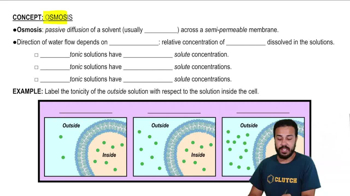
Osmosis is the movement of solvent molecules through a selectively permeable membrane from a region of lower solute concentration to a region of higher solute concentration. This process aims to equalize solute concentrations on both sides, often causing a change in fluid levels.
Recommended video:
05:59
Osmosis

Solute Concentration and Fluid Level Relationship

When two solutions are separated by a selectively permeable membrane, the side with higher solute concentration draws solvent in, increasing its fluid level. Therefore, an increase in fluid level on side A indicates that side B initially had the higher solute concentration.
Recommended video:
07:16
Osmoregulation and Nitrogenous Waste