Ch. 21 Blood Vessels and Circulation
Martini - Fundamentals of Anatomy & Physiology 11th Edition
Martini, Nath, Bartholomew11th EditionFundamentals of Anatomy & PhysiologyISBN: 9780136874089Not the one you use?Change textbook
Chapter 21, Problem 22

Relate the anatomical differences between arteries and veins to their functions.

Verified step by step guidance
1
Identify the primary functions of arteries and veins: arteries carry blood away from the heart, typically oxygenated blood (except in the case of pulmonary arteries), while veins return blood to the heart, typically deoxygenated blood (except in the case of pulmonary veins).
Examine the structural differences in the walls of arteries and veins: arteries have thicker walls with more smooth muscle and elastic fibers to withstand higher pressure from blood being pumped by the heart, while veins have thinner walls and less smooth muscle since they operate under lower pressure.
Discuss the presence of valves in veins: veins contain valves to prevent backflow of blood as it moves toward the heart, especially in the lower extremities where blood must travel against gravity. Arteries do not have valves because the high pressure ensures unidirectional flow.
Relate the lumen size to function: arteries have smaller lumens relative to their wall thickness to maintain high pressure for efficient blood flow, while veins have larger lumens to accommodate the lower pressure and larger volume of blood returning to the heart.
Connect the elasticity of arteries to their role in maintaining blood pressure: the elastic fibers in arterial walls allow them to stretch and recoil, helping to maintain consistent blood pressure during the cardiac cycle. Veins, lacking significant elasticity, rely on surrounding skeletal muscle contractions to assist blood flow.

Verified video answer for a similar problem:

This video solution was recommended by our tutors as helpful for the problem above.
Was this helpful?

Key Concepts

Here are the essential concepts you must grasp in order to answer the question correctly.

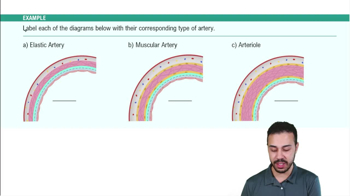
Arterial Structure

Arteries have thick, muscular walls that are elastic, allowing them to withstand and regulate the high pressure of blood pumped from the heart. This structure enables arteries to maintain blood flow and pressure, facilitating efficient transport of oxygenated blood to various body tissues.
Recommended video:
1:42
Arteries Example 1

Venous Structure

Veins possess thinner walls compared to arteries and have larger lumens, which accommodate the lower pressure of blood returning to the heart. Many veins also contain valves that prevent backflow, ensuring that blood moves in one direction despite the lower pressure, which is crucial for effective circulation.
Recommended video:
Guided course
4:16
Structure of the Eyeball Example 1

Functional Implications

The structural differences between arteries and veins directly relate to their functions in the circulatory system. Arteries are designed for high-pressure transport of oxygen-rich blood away from the heart, while veins are adapted for the low-pressure return of deoxygenated blood, highlighting the importance of their anatomical features in maintaining efficient blood circulation.
Recommended video:
06:04
Functional Groups