Ch. 27 Fluids & Electrolytes
Martini - Fundamentals of Anatomy & Physiology 11th Edition
Martini, Nath, Bartholomew11th EditionFundamentals of Anatomy & PhysiologyISBN: 9780136874089Not the one you use?Change textbook
Chapter 26, Problem 19

What are the three major buffer systems in body fluids? How does each system work?

Verified step by step guidance
1
Identify the three major buffer systems in body fluids: the bicarbonate buffer system, the phosphate buffer system, and the protein buffer system.
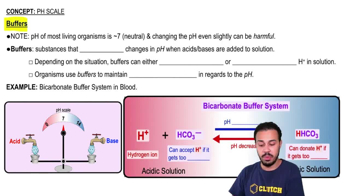
Explain the bicarbonate buffer system: it involves a reversible reaction between carbonic acid (H2CO3) and bicarbonate ions (HCO3\^-), which helps maintain pH by neutralizing excess acids or bases in the blood.
Describe the phosphate buffer system: it uses dihydrogen phosphate (H2PO4\^-) and hydrogen phosphate (HPO4\^{2-}) ions to buffer pH changes, especially in intracellular fluids and the kidneys, by accepting or donating hydrogen ions (H\^+).
Discuss the protein buffer system: proteins, especially hemoglobin in red blood cells, contain amino acid side chains that can bind or release hydrogen ions, thus helping to stabilize pH within cells and blood plasma.
Summarize how each system works by either accepting hydrogen ions when the fluid is too acidic or donating hydrogen ions when the fluid is too basic, thereby maintaining the acid-base balance essential for physiological functions.

Verified video answer for a similar problem:

This video solution was recommended by our tutors as helpful for the problem above.
Was this helpful?

Key Concepts

Here are the essential concepts you must grasp in order to answer the question correctly.

Bicarbonate Buffer System

The bicarbonate buffer system is the primary extracellular buffer that maintains blood pH by balancing carbonic acid (H2CO3) and bicarbonate ions (HCO3-). It works through reversible reactions where carbonic acid dissociates into hydrogen ions and bicarbonate, helping neutralize excess acids or bases in the body.
Recommended video:
05:38
Buffers

Phosphate Buffer System

The phosphate buffer system operates mainly in intracellular fluids and the kidneys, using dihydrogen phosphate (H2PO4-) and hydrogen phosphate (HPO4^2-) ions. It stabilizes pH by accepting or donating hydrogen ions, thus buffering changes in acid-base balance within cells and urine.
Recommended video:
05:38
Buffers

Protein Buffer System

Proteins, especially hemoglobin in red blood cells, act as buffers by binding or releasing hydrogen ions through their amino acid side chains. This system helps regulate pH inside cells and in the blood by neutralizing excess acids or bases, contributing significantly to acid-base homeostasis.
Recommended video:
05:38
Buffers