Simplify each expression. Write answers without negative exponents. Assume all variables represent positive real numbers. (27/64)-4/3
Verified step by step guidance
1
Recognize that the expression is a power raised to another power: \(\left( \frac{27}{64} \right)^{-\frac{4}{3}}\). Use the property of exponents: \(\left( a^m \right)^n = a^{m \cdot n}\), which means you can rewrite the expression as \(\left( \frac{27}{64} \right)^{-\frac{4}{3}}\) without change, but this helps us think about simplifying the base first.
Rewrite the base numbers as powers of their prime factors: \$27 = 3^3\( and \)64 = 4^3 = 2^6\(, but since \)64 = 2^6\( is not a perfect cube, let's use \)64 = 4^3\( is incorrect. Actually, \)64 = 2^6\(, but since the exponent is \(-\frac{4}{3}\), it's easier to write \)64 = 4^3\( is incorrect. Instead, write \)64 = 4^3\( is wrong; the correct prime factorization is \)64 = 2^6$. So, rewrite the fraction as \(\left( \frac{3^3}{2^6} \right)^{-\frac{4}{3}}\).
Apply the exponent to both numerator and denominator separately: \(\left( 3^3 \right)^{-\frac{4}{3}}\) and \(\left( 2^6 \right)^{-\frac{4}{3}}\). Use the power of a power rule: \(\left( a^m \right)^n = a^{m \cdot n}\), so the numerator becomes \(3^{3 \times -\frac{4}{3}}\) and the denominator becomes \(2^{6 \times -\frac{4}{3}}\).
Simplify the exponents by multiplying: For the numerator, \(3 \times -\frac{4}{3} = -4\), so the numerator is \$3^{-4}\(. For the denominator, \(6 \times -\frac{4}{3} = -8\), so the denominator is \)2^{-8}$. The expression is now \(\frac{3^{-4}}{2^{-8}}\).
Rewrite the expression to eliminate negative exponents by using the rule \(a^{-m} = \frac{1}{a^m}\). So, \(3^{-4} = \frac{1}{3^4}\) and \(2^{-8} = \frac{1}{2^8}\). Since the denominator has a negative exponent, it moves to the numerator as a positive exponent. Therefore, the expression becomes \(\frac{1}{3^4} \times 2^8\), which can be written as \(\frac{2^8}{3^4}\).
Verified video answer for a similar problem:
This video solution was recommended by our tutors as helpful for the problem above
Video duration:
5m
Play a video:
0 Comments
Key Concepts
Here are the essential concepts you must grasp in order to answer the question correctly.
Negative Exponents
A negative exponent indicates the reciprocal of the base raised to the corresponding positive exponent. For example, a^(-n) = 1/a^n. Simplifying expressions with negative exponents often involves rewriting them without negatives by taking reciprocals.
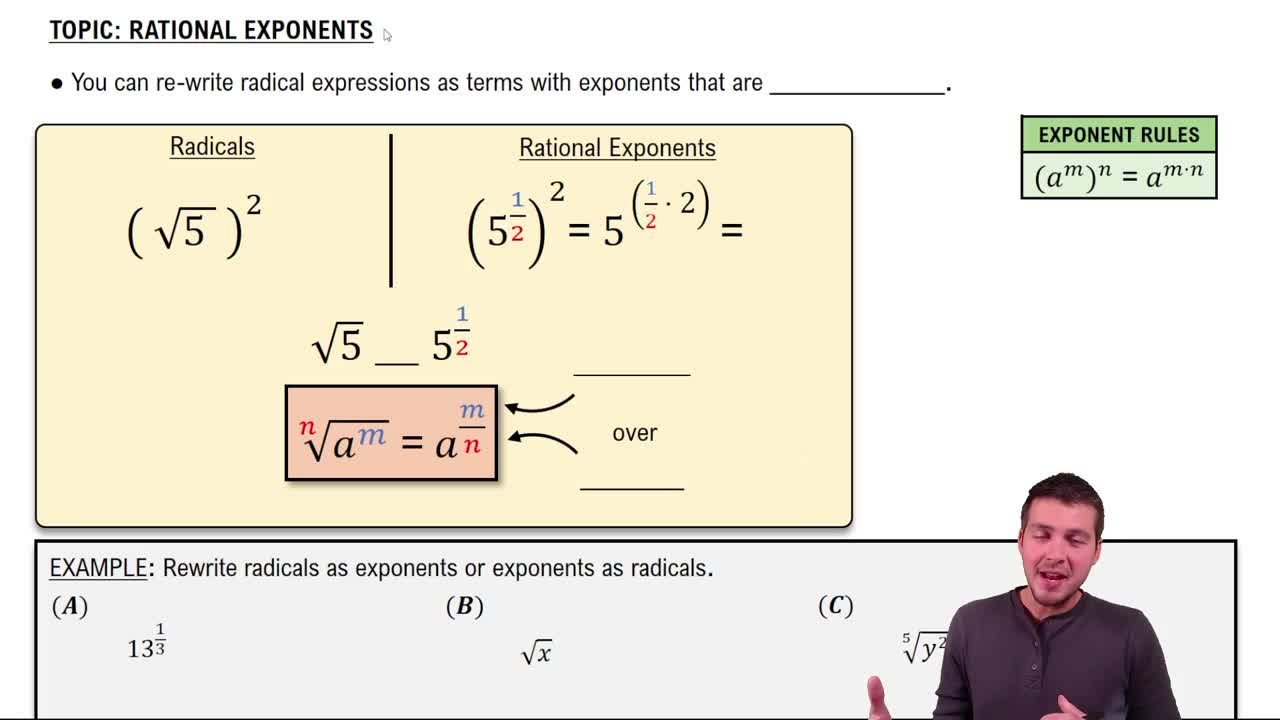
Rational exponents represent roots and powers simultaneously. An expression like a^(m/n) means the nth root of a raised to the mth power, or (√[n]{a})^m. Understanding this helps simplify expressions involving fractional powers.
Exponent rules such as (a^m)^n = a^(mn) and (a/b)^m = a^m / b^m allow simplification of complex expressions. Recognizing how to apply these properties to both numerator and denominator is essential for rewriting expressions without negative exponents.

 5:39 minutes
 Verified step by step guidance
 6:37
6:37