Graph the solution set of each system of inequalities.
Table of contents
- 0. Review of Algebra4h 18m
- 1. Equations & Inequalities3h 18m
- 2. Graphs of Equations1h 43m
- 3. Functions2h 17m
- 4. Polynomial Functions1h 44m
- 5. Rational Functions1h 23m
- 6. Exponential & Logarithmic Functions2h 28m
- 7. Systems of Equations & Matrices4h 5m
- 8. Conic Sections2h 23m
- 9. Sequences, Series, & Induction1h 22m
- 10. Combinatorics & Probability1h 45m
7. Systems of Equations & Matrices
Graphing Systems of Inequalities
Problem 66
Textbook Question
Graph the solution set of each system of inequalities.
ex−y≤1
x−2y≥4
Verified step by step guidance1
Step 1: Start by graphing the first inequality, \( e^x - y \leq 1 \). To do this, first graph the boundary line \( y = e^x - 1 \). This is an exponential function shifted down by 1 unit. Plot several points for \( x \) values and connect them to form the curve.
Step 2: Determine which side of the boundary line \( y = e^x - 1 \) to shade. Choose a test point not on the line, such as (0,0). Substitute into the inequality: \( e^0 - 0 \leq 1 \) simplifies to \( 1 \leq 1 \), which is true. Therefore, shade the region below the curve.
Step 3: Next, graph the second inequality, \( x - 2y \geq 4 \). Start by graphing the boundary line \( x - 2y = 4 \). Rearrange to slope-intercept form: \( y = \frac{x}{2} - 2 \). Plot the y-intercept at (0, -2) and use the slope \( \frac{1}{2} \) to find another point.
Step 4: Determine which side of the line \( y = \frac{x}{2} - 2 \) to shade. Use the test point (0,0) again: \( 0 - 2(0) \geq 4 \) simplifies to \( 0 \geq 4 \), which is false. Therefore, shade the region above the line.
Step 5: The solution set of the system of inequalities is the region where the shaded areas from both inequalities overlap. Identify this region on the graph, ensuring to use dashed or solid lines appropriately based on whether the inequalities are strict or inclusive.
Verified video answer for a similar problem:This video solution was recommended by our tutors as helpful for the problem above
Video duration:
9mPlay a video:
Was this helpful?
Key Concepts
Here are the essential concepts you must grasp in order to answer the question correctly.
Inequalities
Inequalities are mathematical expressions that show the relationship between two values when they are not equal. They can be represented using symbols such as ≤ (less than or equal to) and ≥ (greater than or equal to). Understanding how to manipulate and graph inequalities is crucial for solving systems of inequalities, as it allows us to determine the regions of the coordinate plane that satisfy the given conditions.
Recommended video:
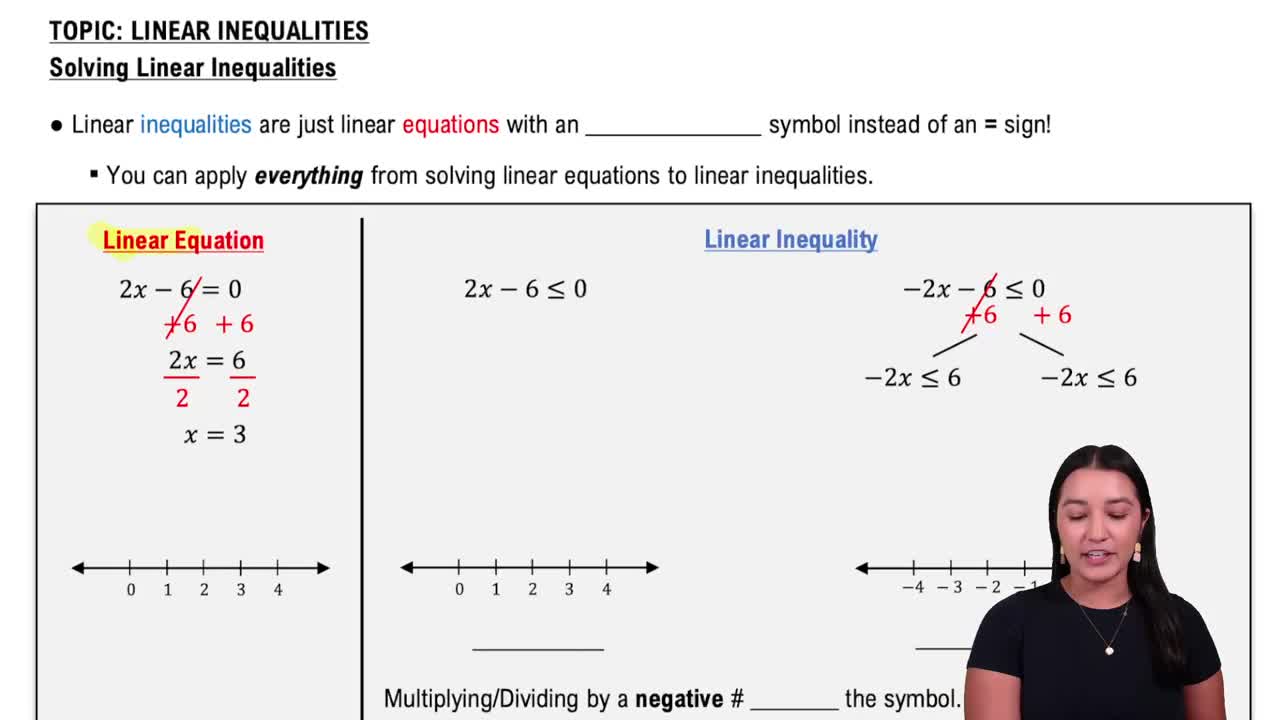
Linear Inequalities
Graphing Systems of Inequalities
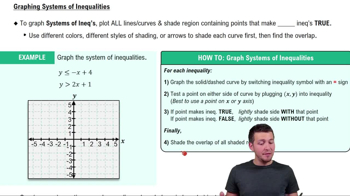
Graphing systems of inequalities involves plotting each inequality on a coordinate plane and identifying the overlapping region that satisfies all inequalities simultaneously. Each inequality divides the plane into two regions, and the solution set is typically represented by shading the area that meets all conditions. This visual representation helps in understanding the feasible solutions for the system.
Recommended video:
Guided course
Systems of Inequalities
Exponential Functions
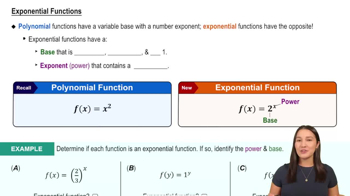
Exponential functions, such as e^x, are functions where a constant base is raised to a variable exponent. They exhibit rapid growth or decay and are essential in various applications, including modeling real-world phenomena. In the context of the given inequality, understanding the behavior of the exponential function is necessary to accurately graph the inequality involving e^x and determine the solution set.
Recommended video:
Exponential Functions
Related Videos
Related Practice
Textbook Question
390
views