Graph the solution set of each system of inequalities.
Verified step by step guidance
1
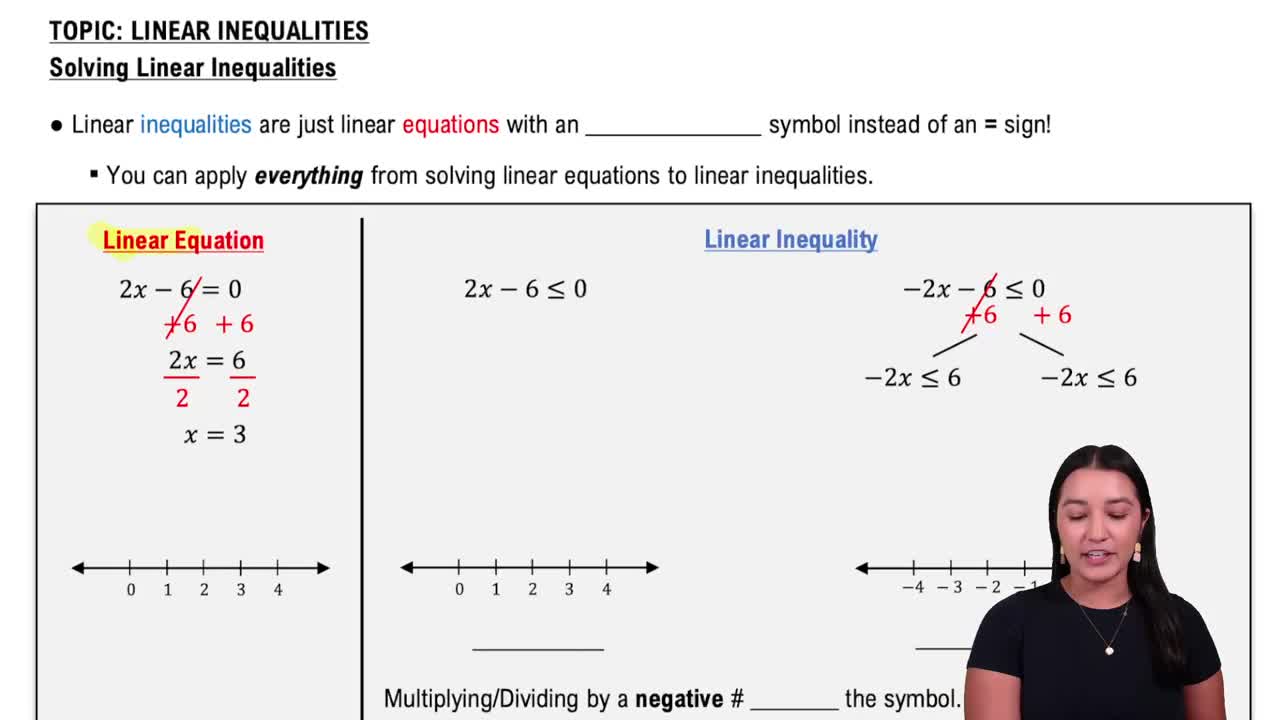
Rewrite each inequality in slope-intercept form (y = mx + b) to make graphing easier. For the first inequality, start with \$3x - 2y \ge 6\(. Solve for \)y\( by isolating it on one side: subtract \)3x\( from both sides and then divide by \)-2$. Remember to reverse the inequality sign when dividing by a negative number.
For the second inequality, \(x + y \le -5\), solve for \(y\) by subtracting \(x\) from both sides to get \(y \le -x - 5\). This is already in slope-intercept form.
The third inequality is \(y \le 4\), which is a horizontal line at \(y = 4\). The solution includes all points on or below this line.
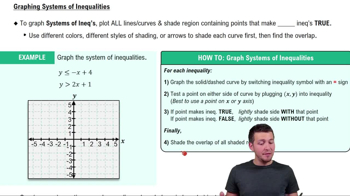
Graph each boundary line on the coordinate plane. Use a solid line for inequalities with \( \ge \) or \( \le \) because points on the line satisfy the inequality. For each line, identify the slope and y-intercept from the slope-intercept form to plot accurately.
Determine the solution region by shading the appropriate side of each boundary line. For each inequality, pick a test point not on the line (like the origin if it’s not on the line) to check if it satisfies the inequality. The solution set of the system is the intersection of all shaded regions.
Verified video answer for a similar problem:
This video solution was recommended by our tutors as helpful for the problem above
Video duration:
9m
Play a video:
Was this helpful?
Key Concepts
Here are the essential concepts you must grasp in order to answer the question correctly.
Graphing Linear Inequalities
Graphing linear inequalities involves first graphing the related linear equation as a boundary line. The inequality symbol determines whether the boundary is solid (≥ or ≤) or dashed (> or <). Then, shading the region that satisfies the inequality shows the solution set on the coordinate plane.
A system of inequalities consists of two or more inequalities considered together. The solution set is the intersection of the individual solution regions, representing all points that satisfy every inequality simultaneously. Graphing helps visualize this common solution area.
Interpreting Inequality Symbols and Boundary Lines
Inequality symbols (≥, ≤, >, <) indicate whether points on the boundary line are included in the solution set. Solid lines include points (≥, ≤), while dashed lines exclude them (> , <). Understanding this distinction is crucial for accurately graphing and identifying the solution region.