Graph the solution set of each system of inequalities.
Table of contents
- 0. Review of Algebra4h 18m
- 1. Equations & Inequalities3h 18m
- 2. Graphs of Equations1h 43m
- 3. Functions2h 17m
- 4. Polynomial Functions1h 44m
- 5. Rational Functions1h 23m
- 6. Exponential & Logarithmic Functions2h 28m
- 7. Systems of Equations & Matrices4h 5m
- 8. Conic Sections2h 23m
- 9. Sequences, Series, & Induction1h 22m
- 10. Combinatorics & Probability1h 45m
7. Systems of Equations & Matrices
Graphing Systems of Inequalities
Problem 65
Textbook Question
Graph the solution set of each system of inequalities.
Verified step by step guidance1
Identify the domain and shape of each inequality. For the first inequality, \(y \leq \log x\), note that the logarithm function \(\log x\) is defined only for \(x > 0\). The graph of \(y = \log x\) is a curve increasing slowly and passing through the point \((1,0)\).
For the second inequality, \(y \geq |x - 2|\), recognize that \(y = |x - 2|\) is a V-shaped graph with its vertex at \((2,0)\). The inequality \(y \geq |x - 2|\) means the solution includes the region on or above this V-shaped graph.
Graph the boundary lines first: plot \(y = \log x\) for \(x > 0\) and \(y = |x - 2|\) for all real \(x\). Use a solid line for both since the inequalities include equality (\(\leq\) and \(\geq\)).
Determine the solution regions for each inequality separately. For \(y \leq \log x\), shade the region below or on the curve \(y = \log x\). For \(y \geq |x - 2|\), shade the region above or on the V-shaped graph.
Find the intersection of the two shaded regions from the previous step. The solution set of the system is where both shaded regions overlap. This overlapping region satisfies both inequalities simultaneously.
Verified video answer for a similar problem:This video solution was recommended by our tutors as helpful for the problem above
Video duration:
10mPlay a video:
Was this helpful?
Key Concepts
Here are the essential concepts you must grasp in order to answer the question correctly.
Graphing Inequalities
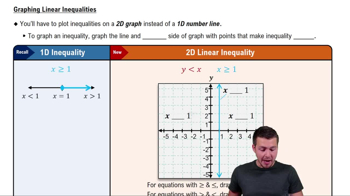
Graphing inequalities involves shading the region of the coordinate plane that satisfies the inequality. For example, y ≤ f(x) means shading all points on or below the curve y = f(x). Understanding how to represent inequalities graphically helps visualize solution sets for systems of inequalities.
Recommended video:
Guided course
Linear Inequalities
Logarithmic Functions
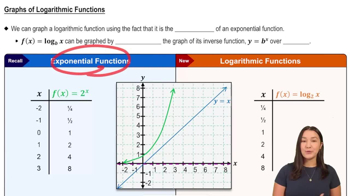
A logarithmic function, such as y = log x, is the inverse of an exponential function. It is defined only for x > 0 and has a characteristic curve that increases slowly and passes through (1,0). Knowing its domain and shape is essential for correctly graphing inequalities involving logarithms.
Recommended video:
Graphs of Logarithmic Functions
Absolute Value Functions
The absolute value function y = |x - a| creates a V-shaped graph with its vertex at (a, 0). It outputs the distance of x from a, always non-negative. When graphing inequalities like y ≥ |x - 2|, the solution includes points on or above this V-shaped graph.
Recommended video:
Function Composition
Related Videos
Related Practice
Textbook Question
500
views