Graph each function. Give the domain and range. ƒ(x) = | log2 (x+3) |
Table of contents
- 0. Review of Algebra4h 18m
- 1. Equations & Inequalities3h 18m
- 2. Graphs of Equations1h 43m
- 3. Functions2h 17m
- 4. Polynomial Functions1h 44m
- 5. Rational Functions1h 23m
- 6. Exponential & Logarithmic Functions2h 28m
- 7. Systems of Equations & Matrices4h 5m
- 8. Conic Sections2h 23m
- 9. Sequences, Series, & Induction1h 22m
- 10. Combinatorics & Probability1h 45m
6. Exponential & Logarithmic Functions
Introduction to Logarithms
Problem 65
Textbook Question
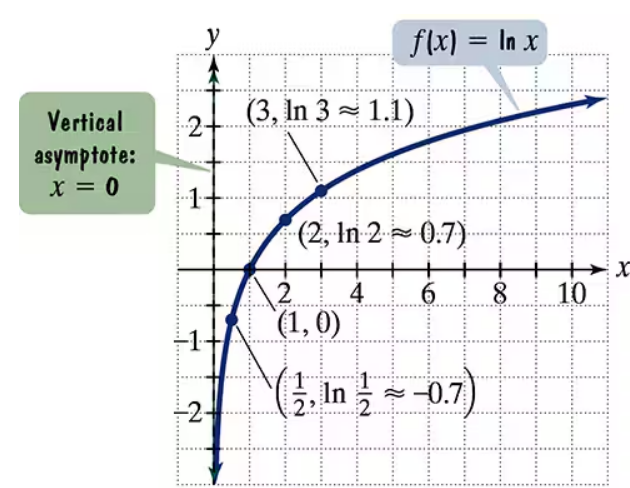
The figure shows the graph of f(x) = ln x. In Exercises 65–74, use transformations of this graph to graph each function. Graph and give equations of the asymptotes. Use the graphs to determine each function's domain and range. g(x) = ln (x+2)

Verified step by step guidance1
Identify the base function: The given function is \( f(x) = \ln x \), which is the natural logarithm function with domain \( (0, \infty) \) and range \( (-\infty, \infty) \). Its vertical asymptote is the line \( x = 0 \).
Analyze the transformation: The function \( g(x) = \ln (x + 2) \) represents a horizontal shift of the base function \( f(x) = \ln x \) to the left by 2 units because the input \( x \) is replaced by \( x + 2 \).
Determine the new domain: Since the argument of the logarithm must be positive, set \( x + 2 > 0 \). Solve this inequality to find the domain of \( g(x) \).
Find the new vertical asymptote: The vertical asymptote occurs where the argument of the logarithm is zero, so set \( x + 2 = 0 \) and solve for \( x \) to find the equation of the asymptote.
Describe the range: The range of \( g(x) = \ln (x + 2) \) remains the same as the base function \( f(x) = \ln x \), which is \( (-\infty, \infty) \), because vertical shifts or horizontal shifts do not affect the range of the logarithmic function.
Verified video answer for a similar problem:This video solution was recommended by our tutors as helpful for the problem above
Video duration:
5mPlay a video:
Was this helpful?
Key Concepts
Here are the essential concepts you must grasp in order to answer the question correctly.
Natural Logarithm Function
The natural logarithm function, denoted as ln(x), is the inverse of the exponential function e^x. It is defined only for positive x-values and has a vertical asymptote at x = 0. Understanding its basic shape and properties is essential for graph transformations.
Recommended video:
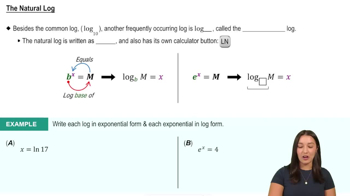
The Natural Log
Graph Transformations
Graph transformations involve shifting, stretching, or reflecting the graph of a function. For g(x) = ln(x + 2), the graph of ln(x) shifts horizontally left by 2 units. Recognizing how changes inside the function's argument affect the graph helps in sketching and analyzing new functions.
Recommended video:
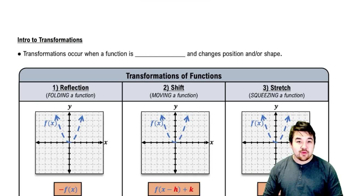
Intro to Transformations
Domain, Range, and Asymptotes
The domain of ln(x) is (0, ∞), and its range is (-∞, ∞). Horizontal or vertical shifts affect the domain and location of asymptotes. For g(x) = ln(x + 2), the vertical asymptote moves to x = -2, and the domain becomes (-2, ∞), while the range remains all real numbers.
Recommended video:
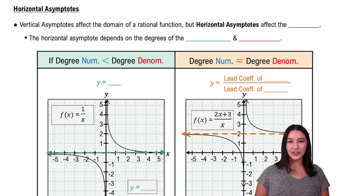
Determining Horizontal Asymptotes
Watch next
Master Logarithms Introduction with a bite sized video explanation from Patrick
Start learningRelated Videos
Related Practice
Textbook Question
761
views
