Let U = {0, 1, 2, 3, 4, 5, 6, 7, 8, 9, 10, 11, 12, 13}, M = {0, 2, 4, 6, 8}, N = {1, 3, 5, 7, 9, 11, 13}, Q = {0, 2, 4, 6, 8, 10, 12}, and R = {0, 1, 2, 3, 4}.Use these sets to find each of the following. Identify any disjoint sets. M ∩ N
Table of contents
- 0. Review of Algebra4h 18m
- 1. Equations & Inequalities3h 18m
- 2. Graphs of Equations1h 43m
- 3. Functions2h 17m
- 4. Polynomial Functions1h 44m
- 5. Rational Functions1h 23m
- 6. Exponential & Logarithmic Functions2h 28m
- 7. Systems of Equations & Matrices4h 5m
- 8. Conic Sections2h 23m
- 9. Sequences, Series, & Induction1h 22m
- 10. Combinatorics & Probability1h 45m
0. Review of Algebra
Exponents
Problem 86
Textbook Question
Evaluate each expression without using a calculator. 271/3
Verified step by step guidance1
Recognize that the expression \$27^{1/3}\( represents the cube root of 27, because an exponent of \)\frac{1}{3}$ means the cube root.
Rewrite the expression as \(\sqrt[3]{27}\) to make it clearer that we are looking for a number which, when multiplied by itself three times, equals 27.
Recall that 27 is a perfect cube since \$3 \times 3 \times 3 = 27$.
Identify that the cube root of 27 is 3 because \$3^3 = 27$.
Therefore, \$27^{1/3}$ simplifies to 3.
Verified video answer for a similar problem:This video solution was recommended by our tutors as helpful for the problem above
Video duration:
59sPlay a video:
Was this helpful?
Key Concepts
Here are the essential concepts you must grasp in order to answer the question correctly.
Exponents and Powers
Exponents represent repeated multiplication of a base number. For example, 27 can be written as 3^3 because 3 multiplied by itself three times equals 27. Understanding how to manipulate exponents is essential for simplifying expressions involving powers.
Recommended video:
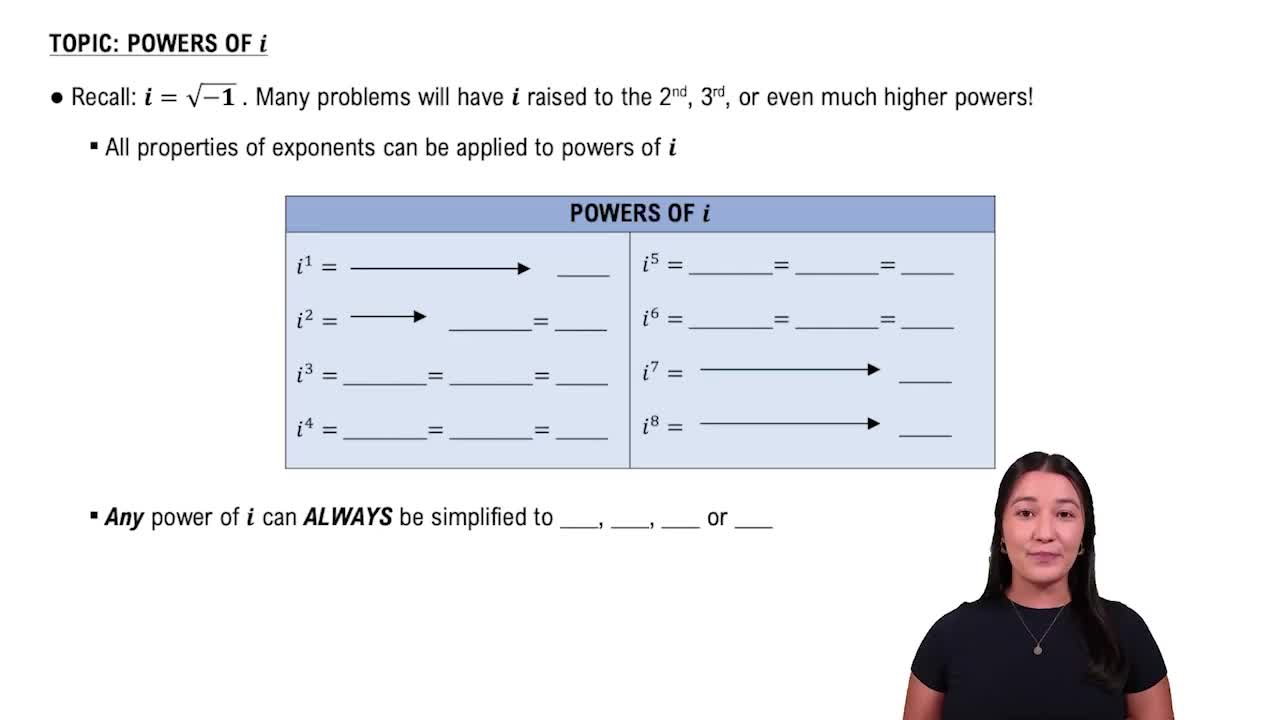
Powers of i
Fractional Exponents
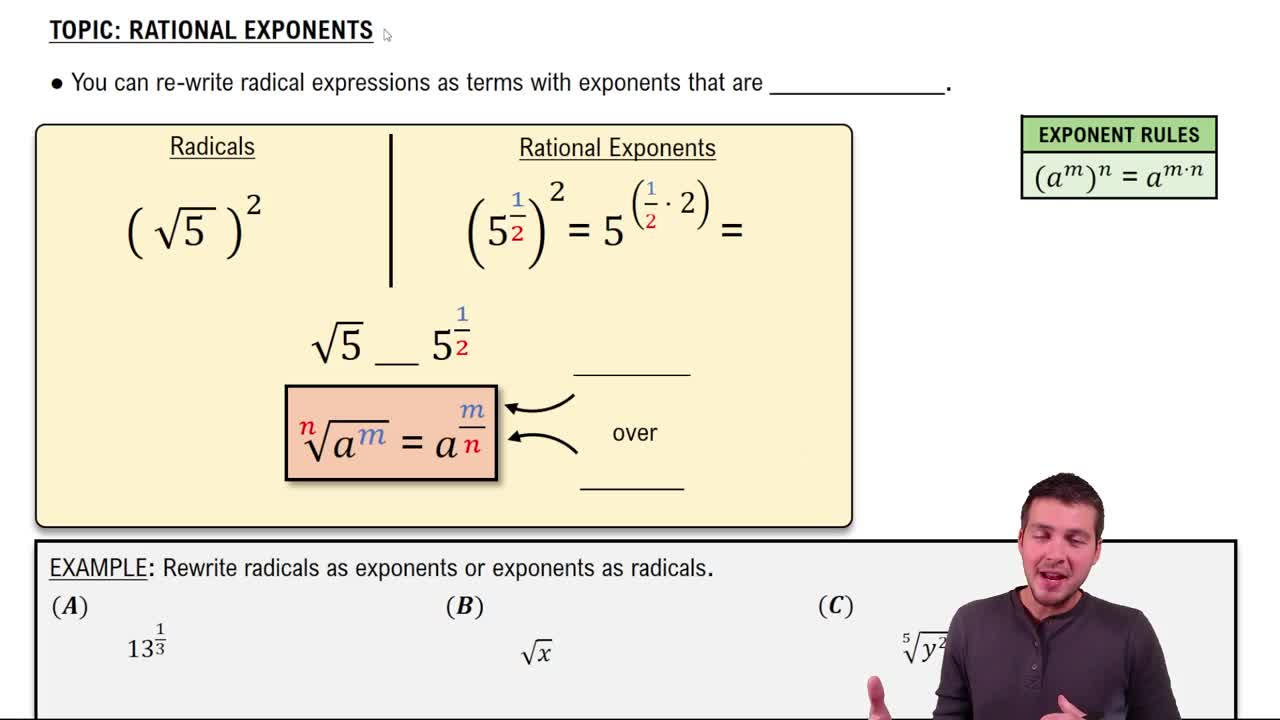
A fractional exponent like 1/3 indicates a root; specifically, the denominator of the fraction is the root's degree. For instance, x^(1/3) means the cube root of x. This concept allows rewriting roots as exponents, facilitating easier evaluation and simplification.
Recommended video:
Guided course
Rational Exponents
Evaluating Cube Roots
The cube root of a number is the value that, when multiplied by itself three times, gives the original number. For example, the cube root of 27 is 3 because 3^3 = 27. Recognizing perfect cubes helps in evaluating expressions like 27^(1/3) without a calculator.
Recommended video:
Imaginary Roots with the Square Root Property
Watch next
Master Introduction to Exponent Rules with a bite sized video explanation from Patrick
Start learningRelated Videos
Related Practice
Textbook Question
800
views