Convert each equation to standard form by completing the square on x and y. Then graph the ellipse and give the location of its foci. 9x2 +25y² - 36x + 50y – 164 = 0
Table of contents
- 0. Review of Algebra4h 18m
- 1. Equations & Inequalities3h 18m
- 2. Graphs of Equations1h 43m
- 3. Functions2h 17m
- 4. Polynomial Functions1h 44m
- 5. Rational Functions1h 23m
- 6. Exponential & Logarithmic Functions2h 28m
- 7. Systems of Equations & Matrices4h 5m
- 8. Conic Sections2h 23m
- 9. Sequences, Series, & Induction1h 22m
- 10. Combinatorics & Probability1h 45m
8. Conic Sections
Ellipses: Standard Form
Problem 57
Textbook Question
Convert each equation to standard form by completing the square on x and y. Then graph the ellipse and give the location of its foci. 25x²+4y² – 150x + 32y + 189 = 0
Verified step by step guidance1
Start by grouping the x-terms and y-terms together and move the constant to the other side: \$25x^{2} - 150x + 4y^{2} + 32y = -189$.
Factor out the coefficients of the squared terms from their respective groups: \$25(x^{2} - 6x) + 4(y^{2} + 8y) = -189$.
Complete the square for each group inside the parentheses. For \(x^{2} - 6x\), take half of -6, square it, and add inside the parentheses. Do the same for \(y^{2} + 8y\). Remember to balance the equation by adding the equivalent values outside the parentheses multiplied by their coefficients.
Rewrite the equation with the completed squares as perfect square trinomials: \$25(x - h)^{2} + 4(y + k)^{2} = C\(, where \)h\( and \)k\( are the values found from completing the square, and \)C$ is the new constant on the right side.
Divide the entire equation by \(C\) to get the standard form of the ellipse: \(\frac{(x - h)^{2}}{a^{2}} + \frac{(y + k)^{2}}{b^{2}} = 1\). Then identify \(a\), \(b\), and calculate the foci using \(c^{2} = |a^{2} - b^{2}|\), where the foci are located at \((h \pm c, k)\) or \((h, k \pm c)\) depending on the major axis.
Verified video answer for a similar problem:This video solution was recommended by our tutors as helpful for the problem above
Video duration:
12mPlay a video:
Was this helpful?
Key Concepts
Here are the essential concepts you must grasp in order to answer the question correctly.
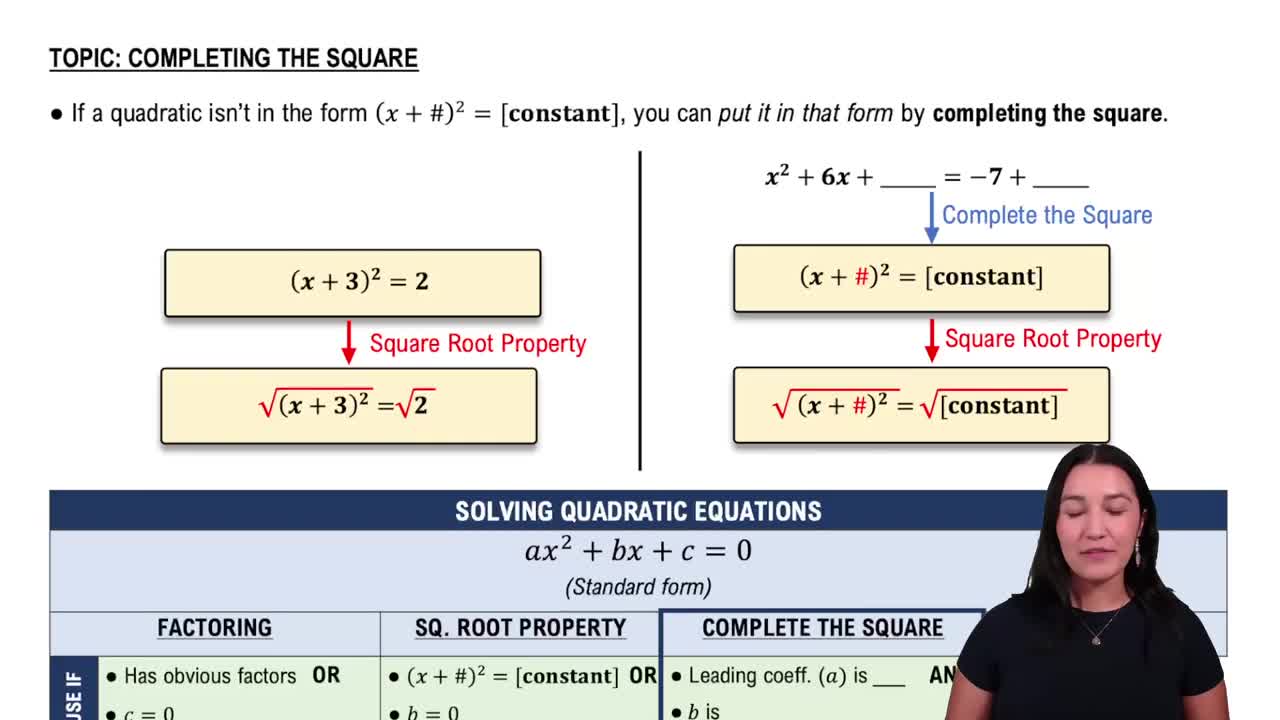
Completing the Square
Completing the square is a method used to rewrite quadratic expressions in the form (x - h)² or (y - k)² by adding and subtracting appropriate constants. This technique helps convert the given equation into the standard form of conic sections, making it easier to analyze and graph.
Recommended video:
Solving Quadratic Equations by Completing the Square
Standard Form of an Ellipse
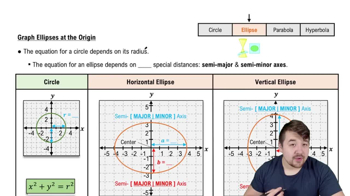
The standard form of an ellipse equation is (x - h)²/a² + (y - k)²/b² = 1, where (h, k) is the center, and a and b are the lengths of the semi-major and semi-minor axes. Converting to this form allows identification of the ellipse’s size, shape, and position on the coordinate plane.
Recommended video:
Graph Ellipses at Origin
Foci of an Ellipse
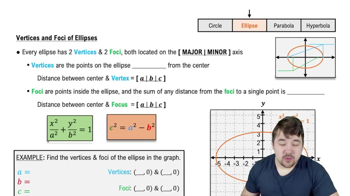
The foci are two fixed points inside an ellipse such that the sum of the distances from any point on the ellipse to the foci is constant. Their locations depend on the values of a and b, and can be found using c² = |a² - b²|, where c is the distance from the center to each focus along the major axis.
Recommended video:
Foci and Vertices of an Ellipse
Watch next
Master Graph Ellipses at Origin with a bite sized video explanation from Patrick
Start learningRelated Videos
Related Practice
Textbook Question
547
views