In Exercises 51–56, graph each relation. Use the relation's graph to determine its domain and range.
Verified step by step guidance
1
Recognize that the given equation \(\frac{x^2}{9} + \frac{y^2}{16} = 1\) represents an ellipse centered at the origin, where the denominators 9 and 16 correspond to the squares of the ellipse's semi-axes lengths.
Identify the lengths of the semi-major and semi-minor axes: \(a = 3\) (since \$9 = 3^2\() and \)b = 4\( (since \)16 = 4^2$). This means the ellipse stretches 3 units along the x-axis and 4 units along the y-axis.
To graph the ellipse, plot the points \((\pm 3, 0)\) and \((0, \pm 4)\) on the coordinate plane, which are the vertices of the ellipse along the x- and y-axes respectively.
Use the ellipse equation to express \(y\) in terms of \(x\) to understand the shape: rearrange to \(\frac{y^2}{16} = 1 - \frac{x^2}{9}\), then multiply both sides by 16 to get \(y^2 = 16 \left(1 - \frac{x^2}{9}\right)\), and finally take the square root to find \(y = \pm 4 \sqrt{1 - \frac{x^2}{9}}\).
Determine the domain and range from the ellipse: since \(x^2/9 \leq 1\), the domain is \(-3 \leq x \leq 3\); similarly, since \(y^2/16 \leq 1\), the range is \(-4 \leq y \leq 4\).
0 Comments
Key Concepts
Here are the essential concepts you must grasp in order to answer the question correctly.
Equation of an Ellipse
An ellipse is a set of points where the sum of distances to two fixed points (foci) is constant. Its standard form equation is (x²/a²) + (y²/b²) = 1, where a and b are the lengths of the semi-major and semi-minor axes. This equation describes the shape and size of the ellipse on the coordinate plane.
The domain of a relation is the set of all possible x-values, while the range is the set of all possible y-values. For graphs like ellipses, these correspond to the horizontal and vertical extents of the curve. Determining domain and range involves identifying the minimum and maximum values x and y can take.
Graphing conic sections involves plotting points that satisfy their equations and understanding their geometric properties. For ellipses, the graph is symmetric about both axes, with intercepts at ±a on the x-axis and ±b on the y-axis. Recognizing these features helps in sketching the graph accurately.

 Verified step by step guidance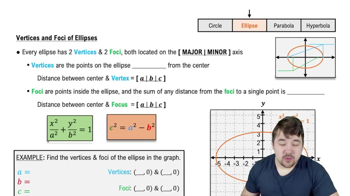
 5:30
5:30